

What is gum contouring?
Gum contouring removes and reshapes excess gum tissue to expose more of the natural tooth, correcting a gummy smile or an uneven gum line. It is usually done with a soft-tissue laser under local anaesthetic.
The aesthetic principle behind it is proportion. A front tooth generally looks right when it is about 10% longer than it is wide, and most people show one to two millimetres of gum when smiling broadly. When the gum sits too low, teeth look short and square even though they are a perfectly normal length — the tooth is simply hidden.
That is why contouring often achieves more than patients expect from such a small procedure. Removing two millimetres of gum across six teeth changes the proportion of every one of them at once.
Why the gum sits low
- Altered passive eruption: the gum never fully receded as the adult teeth came through. The commonest cause, and the easiest to correct.
- Gum overgrowth: from certain medications — some epilepsy, blood pressure and immunosuppressant drugs — or from chronic inflammation.
- A short upper lip, or a lip that lifts unusually high when smiling. Gum surgery helps less here.
- Vertical maxillary excess: the upper jaw is simply longer than average. This is a skeletal problem that gum work cannot fix.
Laser contouring or crown lengthening?
| Laser contouring | Crown lengthening | |
|---|---|---|
| What is removed | Gum tissue only | Gum and a little bone |
| When it is used | Enough tissue above the bone | Bone sits too close to the enamel |
| Anaesthetic | Local | Local, sometimes sedation |
| Healing | 1–2 weeks | 6–8 weeks |
| Risk of rebound | Higher if bone not addressed | Low |
| Price | £250–£400 | £450–£650 |
How the gum line is reshaped
A gummy smile
The teeth may be the right length — the gum is simply sitting low
Reshaping
The gum line is lifted with a laser, under local anaesthetic
The result
More tooth shows without touching a single tooth
How much does gum contouring cost in Turkey?
Velsa charges £250–£650 depending on the number of teeth and whether bone recontouring is needed. The UK equivalent is typically £800–£2,500.
| Treatment | Price (GBP) | Teeth treated | Nights in Turkey |
|---|---|---|---|
| Laser contouring, up to 6 teeth | £250–£350 | 2–6 | 3 |
| Laser contouring, up to 10 teeth | £350–£450 | 6–10 | 3 |
| Crown lengthening, up to 6 teeth | £450–£550 | 2–6 | 4 |
| Crown lengthening, up to 10 teeth | £550–£650 | 6–10 | 4 |
| Added to a veneer or crown package | £300–£450 | Across the smile | Within that trip |
What the package includes
- Examination, X-rays and gum measurement
- Digital smile design showing the planned gum line
- The procedure under local anaesthetic
- Any sutures and dressings needed
- Two nights in a four-star hotel with breakfast
- All airport, hotel and clinic transfers
- A personal English-speaking coordinator
- Antibacterial mouthwash and aftercare pack
- A review appointment before you fly home
- Photographs before and at the final gum position
Travelling for gum contouring alone
Most patients do not. Flights usually cost more than the procedure, so gum contouring makes most sense added to a veneer, crown or whitening trip. When it is part of a smile makeover it is also better dentistry, because the gum line is finalised before impressions are taken for the restorations.
What it costs elsewhere
£250–£650
All-inclusive with Velsa: surgeon, hospital, hotel, transfers and twelve months of aftercare
£1,600+
Typical saving against the UK, mid-range against mid-range, before flights
78%
Less than the typical UK price
Bars span the usual range in each market, not a single quoted figure. Non-Turkish figures are indicative market ranges rather than quotes from named providers.
US and UK figures are typically the surgeon and facility only. Flights, accommodation, transfers and follow-up are extra in those markets and included in the Velsa price, which is the comparison that actually matters.
Your own price comes from a written quote after a clinician has reviewed your case. Nothing on this chart is a quote.
Why do patients from the UK, US and Europe choose Turkey?
Patients choose Turkey for lower all-inclusive prices, experienced cosmetic dentists working with their own laboratories, modern private clinics, short waiting times and easy direct flights from most European and many US cities.
Turkey has become one of the world's leading medical travel destinations. According to Turkish industry figures reported in July 2026, the country welcomed around 1.4 million health tourists in 2025, generating over $3 billion in revenue. Cosmetic and implant dentistry is one of the most requested categories.
- Value: lower operating and living costs mean you pay less for the same standard of treatment.
- Experience: leading dental clinics in Istanbul complete cosmetic and implant cases every week.
- Speed: consultations can be arranged online within days, and treatment dates are flexible.
- Access: most UK and European airports have direct flights of around 3–4 hours.
- Recovery comfort: you recover in a hotel with a coordinator on hand, rather than managing alone at home.
Every Velsa quote names the dentist, the clinic and the laboratory before you pay, so you can check all three yourself.
Am I a good candidate for gum contouring?
The best candidates have healthy gums, teeth that look short because tissue covers them, and enough tooth structure hidden beneath the gum to expose.
Gum contouring is usually suitable if
- Your teeth look short and square although their length is normal.
- You show more than about three millimetres of gum when you smile broadly.
- Your gum line is uneven, with one or two teeth looking noticeably shorter.
- Your gums are healthy, with no untreated periodontal disease.
- You are having veneers or crowns and want the gum line corrected first.
- You are a non-smoker, or can stop around the procedure.
Gum surgery may not be the answer
- Your gummy smile comes from a long upper jaw: this is skeletal and needs orthognathic surgery or orthodontics, not gum work.
- Your upper lip is very short or hypermobile: lip repositioning or botulinum toxin addresses this instead.
- You have untreated gum disease, which must be stabilised first.
- Your gum overgrowth is caused by medication that has not been reviewed — it will simply recur.
- You already have gum recession elsewhere, where removing more tissue is unwise.
- There is insufficient tooth hidden beneath the gum to make a visible difference.
Our self-check below gives you a starting answer, and a Velsa dentist reviews your photographs free of charge and will tell you honestly if the cause is skeletal rather than gingival.
1-minute self-check
Would gum contouring help me?
Answer 6 quick questions to see whether gum contouring is likely to give you the result you want. No personal details needed to see your result.
Your gum contouring appointment, step by step
Two nights in Istanbul, or added to a trip you are already making. The procedure itself takes thirty to sixty minutes.
- 1Before you travel: you send photographs showing a relaxed smile and a broad one. A dentist assesses how much gum shows and whether the cause is gingival or skeletal.
- 2Day 1 — arrival: your driver meets you at Istanbul airport and takes you to the hotel.
- 3Day 2 — assessment and planning: examination, X-rays and probing to measure where the bone sits relative to the enamel. This determines whether a laser alone will hold or whether bone must be recontoured.
- 4Day 2 — the design: the planned gum line is marked on your teeth and shown to you in a mirror before anything is removed. You approve it first.
- 5Day 2 — the procedure: local anaesthetic, then the excess tissue is removed with a soft-tissue laser, which seals as it cuts so there is little bleeding and usually no sutures. Crown lengthening takes longer and may need a small flap and sutures.
- 6Day 2 — immediately after: the new gum line is visible straight away, though it will look slightly red and swollen.
- 7Day 3 — review and fly home: a quick check, aftercare instructions and antibacterial mouthwash.
- 8Weeks 1–2: discomfort settles and the tissue epithelialises.
- 9Weeks 6–8: the gum reaches its final position. This is when impressions for veneers or crowns should be taken, and when the result should be photographed.
Where you will be cared for
Our partner hospital and hotel
See where you will have your surgery and where you will recover, before you travel.


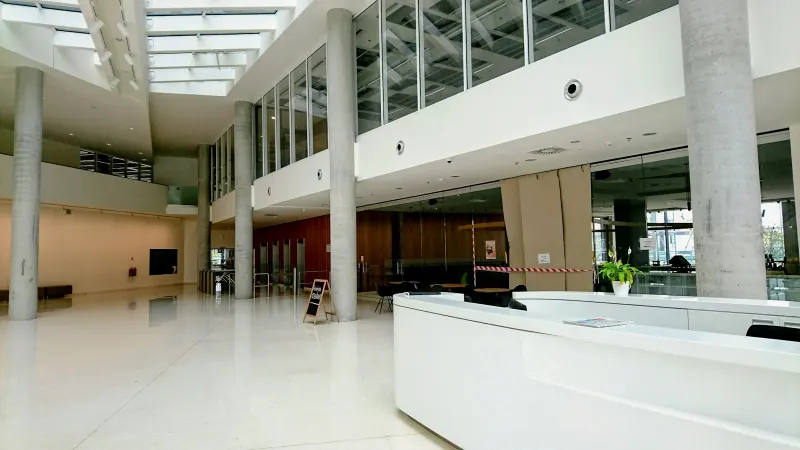

What you can check before you pay
The hospital
- Accreditation
- JCI-accredited, with the certificate number given to you in writing before any deposit.
- Licence
- Turkish Ministry of Health licence, named and verifiable independently rather than described in general terms.
- Intensive care
- On site, in the same building, for every procedure under general anaesthetic. Not "available nearby".
- Anaesthesia
- A consultant anaesthetist present throughout the operation — not supervising several theatres from elsewhere.
- Nursing
- 24-hour nursing, with an English-speaking nurse on each shift and an interpreter for clinical conversations.
Photos are not proof
Photographs show you the rooms; they do not tell you whether there is an intensive care unit behind them. The facility is named to you in writing before you pay, with its licence and accreditation numbers, so you can verify it as well as see it.
If you want to see the building in person, ask — we can usually arrange a visit before you decide, and a provider unwilling to let you look around is telling you something.
How we verify a facility




How is gum contouring performed?
Thirty to sixty minutes under local anaesthetic. A soft-tissue laser cuts and seals simultaneously, so bleeding is minimal and sutures are usually unnecessary.
- 1Assessment: X-rays and periodontal probing establish where the bone crest sits relative to the enamel junction. This is the step that decides whether tissue alone can be removed.
- 2Design: the proposed gum line is drawn on the teeth, following the natural scallop — the gum should sit slightly higher on the canines than on the lateral incisors, not in a straight line.
- 3Your approval: you see the marked design in a mirror before anything is removed.
- 4Anaesthetic: local anaesthetic numbs the gum. You feel pressure but not pain.
- 5Laser removal: a diode or erbium laser removes the excess tissue in small increments, cauterising as it goes. There is a faint smell of burning, which is normal and worth being warned about.
- 6Bone recontouring if needed: where the bone sits too close to the enamel, a small flap is raised and 1–2 mm of bone is carefully reduced to restore biological width, then the flap is sutured back.
- 7Shaping and checking: the margins are refined and symmetry checked with you sitting upright, not lying back.
- 8Dressing: a periodontal dressing is sometimes placed over the area for a few days after crown lengthening. Laser-only cases rarely need one.
Gum contouring recovery timeline
Expect soreness for three to five days and full healing in one to two weeks after laser work, or six to eight weeks where bone was recontoured.
- Days 1–3: tenderness and mild swelling. The treated gum looks white or greyish where the laser sealed it, which is normal and sloughs away.
- Days 3–7: discomfort settles. Soft food, lukewarm drinks, and the prescribed antibacterial mouthwash rather than vigorous brushing over the area.
- Weeks 1–2: laser-treated tissue has healed over. Normal brushing can resume gently.
- Weeks 2–4: colour normalises from red to healthy pink.
- Weeks 6–8: the gum reaches its final position. A small amount of rebound is normal; significant rebound suggests the bone was not addressed.
- After 8 weeks: this is the point at which veneer or crown impressions should be taken, so the laboratory works to the settled gum line.
Is gum contouring safe?
Laser gum contouring is a minor procedure with a low complication rate. The main risk is removing tissue that will simply grow back, or removing too much and exposing the root.
Velsa works with licensed dental clinics in Istanbul whose dentists are registered with the Turkish Ministry of Health. Gum contouring is always preceded by probing and X-rays, because the position of the bone — not the appearance of the gum — determines what can safely be removed.
Risks you should know about
- Rebound: the gum grows back within months, usually because bone was not recontoured where it should have been.
- Over-removal: exposing the root surface, causing lasting sensitivity and an unnaturally long tooth.
- Sensitivity: common and usually temporary where the gum has been reduced near the neck of the tooth.
- Asymmetry: the gum line is scalloped, not straight, and small irregularities can persist.
- Infection: uncommon, and managed with the antibacterial mouthwash provided.
- Bleeding: minimal with a laser, more likely where a flap was raised for bone work.
- Recession later: removing tissue reduces the margin available if gums recede naturally with age.
- Black triangles: where gum is removed between teeth, the papilla may not fill the space, leaving a visible gap.
If your gummy smile is caused by a long upper jaw or a hypermobile lip, gum surgery will give a limited result at best. A dentist who proposes a laser without examining the cause is treating the symptom.
Your medical team
Meet your gum contouring team
You meet your specialist in person before treatment, and they follow your recovery until you are fully healed.
Meet the whole teamFree online consultation
Start your gum contouring journey
- 1Share your detailsFill in the form in under a minute.
- 2Send your photosYour coordinator tells you which photos we need, via WhatsApp or email.
- 3Receive your planA specialist reviews your case and you get a written, all-inclusive quote.
Can gum contouring be combined with other treatment?
It is most often part of a smile makeover, and the sequence is important: gums first, impressions second.
Where contouring is combined with veneers or crowns, it must be done before impressions so the laboratory works to the final gum line. Ideally six to eight weeks before, though in practice many single-trip makeovers contour and prepare in the same week and accept a small compromise.
Commonly combined with
- Veneers or crowns: the most common combination. See Hollywood smile.
- Teeth whitening: done after the gums have healed, so bleaching gel does not contact raw tissue.
- Composite bonding: to reshape the newly exposed tooth where the edge is uneven.
- Frenectomy: releasing a tight upper lip frenum that pulls the lip higher or holds a gap between the front teeth.
- Botulinum toxin to the upper lip: for a hypermobile lip, reducing how far it lifts when smiling. A different solution to the same complaint.
If your assessment shows the cause is skeletal, no combination of gum procedures will give the result you want. Your dentist should say so rather than treating anyway.
How to prepare for gum contouring
Have any gum disease treated first, review medication that causes gum overgrowth, send good smile photographs, and plan soft food for a few days.
- Photographs: send a relaxed smile and a broad one, taken straight on in natural light. How much gum shows when you smile fully is the key measurement.
- Gum health: have a hygienist appointment at home first. Contouring inflamed gums gives an unpredictable result.
- Medication: tell your dentist about any epilepsy, blood pressure or immunosuppressant medication — several cause gum overgrowth, and contouring without addressing them means it recurs.
- Smoking: stop around the procedure if you can. Smoking impairs gum healing noticeably.
- Timing: if this is part of a smile makeover, allow six to eight weeks between contouring and veneer impressions where your schedule permits.
- Packing list: soft food, a soft toothbrush and your regular medication.
Gum contouring results and how long they last
Where the bone has been assessed and addressed, the result is permanent. Where only tissue was removed above a bone crest that was too high, rebound within six to twelve months is common.
The visual effect is often larger than the procedure suggests. Exposing two millimetres of enamel across the front six teeth changes the proportion of all of them, and patients frequently describe the result as looking like they had their teeth straightened rather than their gums trimmed.
Maintaining it is ordinary gum care: brush along the gum line twice daily, clean between the teeth, and see a hygienist twice a year. Gum disease is what undoes this result over time, and it undoes it in the wrong direction — recession rather than regrowth. As consented cases are added, our dental before and after gallery shows cases photographed at the settled eight-week position.
FAQ
Gum contouring in Turkey: frequently asked questions
At Velsa, £250–£450 for laser contouring and £450–£650 where bone recontouring is needed, depending on how many teeth are treated. The UK equivalent is typically £800–£2,500. Most patients add it to a veneer or crown trip rather than travelling for it alone.
The procedure is done under local anaesthetic so you should feel pressure rather than pain. Afterwards expect tenderness for three to five days, manageable with simple painkillers. Crown lengthening is more uncomfortable than laser work alone.
If only tissue was removed and the bone sits too close to the enamel, yes — the gum regrows within months to restore biological width. If the bone was recontoured where needed, the result is permanent. This is the single most important question to ask before booking.
Six to eight weeks. The new gum line is visible immediately, but it will be red and swollen for a fortnight and settles over the following month. Judging it earlier is misleading.
Contouring removes gum tissue only. Crown lengthening also reduces a small amount of underlying bone, which is necessary when the bone crest sits too close to the enamel. Probing and X-rays determine which you need — it is not a preference.
If the cause is excess gum tissue, yes, often dramatically. If the cause is a long upper jaw or a lip that lifts very high, gum surgery will give a limited result and other treatments are more appropriate. Your assessment should establish which you have.
Yes, and it usually should be, because the gum line must be finalised before impressions are taken. Ideally six to eight weeks beforehand; in a single-trip makeover it is done in the same week with a small compromise on precision.
Rarely with laser contouring — the laser seals as it cuts. Crown lengthening involves raising a small flap and does need sutures, which dissolve or are removed at a week.
Often slightly, for a few weeks, where the gum has been reduced near the neck of the tooth. Persistent sensitivity suggests root surface has been exposed, which is why conservative removal matters.
No. Gum tissue removed below the level at which it naturally regenerates does not come back. This is why the design is marked and shown to you before anything is removed.
Usually the teeth visible when you smile broadly — typically six to ten on the upper arch. Treating fewer risks a visible step between contoured and untouched teeth.
Soft food and lukewarm drinks for about five days, then normally. Avoid anything sharp or crusty that could traumatise the healing margin, and use the antibacterial mouthwash rather than brushing hard over the area.
Medical disclaimer: This page is for general information only and does not replace a consultation with a qualified surgeon. Prices depend on your individual assessment. Every surgery carries risks, and individual results vary.