

What is chin and jawline contouring?
Chin and jawline contouring covers several different operations that change the shape of the lower third of the face: adding projection to a small chin, defining the angle of the jaw, or reducing a wide or heavy lower face.
They are grouped together on this page because patients usually arrive describing a look rather than a procedure — "I want a sharper jawline", "my chin is weak", "my face is too round at the bottom". The right operation depends on which structure is actually responsible, and getting that wrong is how people end up with a chin implant when their problem was their bite.
The options, and what each one does
| Procedure | What it does | Reversible? | Price |
|---|---|---|---|
| Chin implant | Adds forward projection and width | Yes, removable | £1,800–£2,600 |
| Sliding genioplasty | Moves your own chin bone forward | No | £2,600–£3,600 |
| Jaw angle implants | Defines the angle of the jaw | Yes, removable | £2,400–£3,400 |
| Buccal fat removal | Slims the lower cheek | No | £1,400–£1,900 |
| Chin filler | Temporary projection | Yes, dissolvable | £350–£600 |
| Orthognathic surgery | Corrects jaw position and bite | No | Referred, not offered |
Implant or sliding genioplasty?
- A chin implant is a silicone or porous polyethylene shape placed over the chin bone. Shorter operation, reversible, and ideal for modest forward projection of 3–7 mm.
- A sliding genioplasty cuts the chin bone and moves it forward, fixing it with plates. More surgery, not reversible, but it can advance further, move the chin vertically as well as forward, and carries no risk of implant infection or bone resorption.
- For advancement over about 8 mm, or where the chin is also too long or too short vertically, genioplasty is usually the better operation.
- For a straightforward modest advance in a patient with a normal bite, an implant does the job with less surgery.
Chin and jawline, in profile
A weak chin
A chin set back makes the nose look larger and the jawline soft
Chin implant
A shaped implant placed on the bone through the mouth
Jawline
Filler or an implant along the angle, which changes the profile more than the chin alone
How much does chin and jawline surgery cost in Turkey?
A Velsa all-inclusive package in Istanbul costs £1,800–£3,600 depending on the procedure. The UK equivalent is typically £4,000–£9,000.
| Procedure | Price (GBP) | Hospital nights | Nights in Turkey |
|---|---|---|---|
| Chin implant | £1,800–£2,600 | 1 | 6 |
| Sliding genioplasty | £2,600–£3,600 | 1 | 7 |
| Jaw angle implants | £2,400–£3,400 | 1 | 7 |
| Buccal fat removal | £1,400–£1,900 | Day case | 5 |
| Chin implant with buccal fat removal | £2,600–£3,400 | 1 | 6 |
| Jawline contouring with liposuction to the neck | £2,400–£3,400 | 1 | 7 |
What the package includes
- Surgeon and anaesthetist fees
- One night in a private hospital room
- All pre-operative blood tests and a facial CT or panoramic X-ray
- The implant itself, where used
- Six nights in a four-star hotel with breakfast
- All airport, hotel and hospital transfers
- A personal English-speaking coordinator
- Antibacterial mouthwash for intraoral incisions
- Compression support garment where indicated
- Twelve months of remote aftercare
Imaging is included, and it changes the plan
A panoramic X-ray or facial CT shows where the mental nerve runs, how thick the chin bone is and whether the tooth roots sit in the way. It is also what reveals a bite discrepancy that would make a chin implant the wrong answer. Any clinic planning chin surgery from photographs alone is working blind on the one structure that cannot be undone.
What it costs elsewhere
£1,800–£3,600
All-inclusive with Velsa: surgeon, hospital, hotel, transfers and twelve months of aftercare
£3,800+
Typical saving against the UK, mid-range against mid-range, before flights
58%
Less than the typical UK price
Bars span the usual range in each market, not a single quoted figure. Non-Turkish figures are indicative market ranges rather than quotes from named providers.
US and UK figures are typically the surgeon and facility only. Flights, accommodation, transfers and follow-up are extra in those markets and included in the Velsa price, which is the comparison that actually matters.
Your own price comes from a written quote after a clinician has reviewed your case. Nothing on this chart is a quote.
Why do patients from the UK, US and Europe choose Turkey?
Patients choose Turkey for lower all-inclusive prices, experienced plastic surgeons who operate at high volume, modern private hospitals, short waiting times and easy direct flights from most European and many US cities.
Turkey has become one of the world's leading medical travel destinations. According to Turkish industry figures reported in July 2026, the country welcomed around 1.4 million health tourists in 2025, generating over $3 billion in revenue. Aesthetic surgery is one of the most requested categories.
- Value: lower operating and living costs mean you pay less for the same type of surgery and hospital care.
- Experience: leading surgeons in Istanbul and other major cities perform aesthetic operations every week.
- Speed: consultations can be arranged online within days, and surgery dates are flexible.
- Access: most UK and European airports have direct flights of around 3–4 hours.
- Recovery comfort: you recover in a hotel with a coordinator on hand, rather than managing alone at home.
Every Velsa quote names the surgeon and the hospital before you pay, so you can check both yourself.
Am I a good candidate for chin or jawline contouring?
The best candidates have a specific structural concern, a normal or corrected bite, and realistic expectations about how much the lower face can change.
Surgery is usually suitable if
- Your chin is recessed in profile and your bite is normal.
- Your jaw angle is soft or rounded and you want more definition.
- Your lower cheeks are full and you want a slimmer, more sculpted look.
- Your chin is strong enough but sits too high or too low vertically.
- You have tried filler and want something permanent.
- You are over 18 with fully developed facial bones, and a non-smoker or willing to stop.
You may need something else first
- Your teeth do not meet properly: orthodontics or jaw surgery addresses the cause. A chin implant disguises it.
- Your concern is a double chin rather than bone: liposuction or skin tightening is the answer, not an implant.
- Your jawline has softened with age rather than always been soft: this is jowling, and a facelift addresses it.
- You are under 18: facial bones are still developing.
- You have thin facial tissue and want large jaw angle implants: the edges can become visible.
- You are considering buccal fat removal and are under 25: faces slim naturally with age, and removing fat early can produce a gaunt look later.
Our self-check below gives you a starting answer, and a Velsa plastic surgeon reviews your photographs free of charge and will tell you if the answer is orthodontic rather than surgical.
1-minute self-check
Which lower face procedure suits me?
Answer 6 quick questions to see which procedure matches your concern — or whether the answer is not surgical at all. No personal details needed to see your result.
Your chin and jawline journey in Turkey, day by day
Six to seven nights in Istanbul, depending on the procedure, with imaging on arrival before the plan is finalised.
- 1Before you travel: you send photographs in profile, three-quarter and front view, plus a photograph of your teeth in bite. A plastic surgeon assesses chin position, jaw angle and whether your bite needs addressing first. You receive a written fixed quote.
- 2Day 1 — arrival: your driver meets you at Istanbul airport and takes you to the hotel.
- 3Day 2 — imaging and consultation: a panoramic X-ray or facial CT shows nerve position, bone thickness and tooth roots. Your surgeon confirms implant size or the extent of bony advancement against the imaging, not against the photographs.
- 4Day 3 — surgery: one to two and a half hours depending on the procedure. Most incisions are inside the mouth, so there is no external scar. You wake with a supportive dressing or chin strap.
- 5Day 4 — discharge: dressing checked and you are discharged to the hotel. Swelling is starting and the lower lip may feel numb.
- 6Days 5–6 — rest: swelling peaks around day three to four. Soft food, antibacterial mouthwash after every meal, head elevated.
- 7Day 7 — final check: swelling settling, implant position or fixation checked, and your surgeon confirms you are fit to fly.
- 8Day 8 — fly home with mouthwash and written aftercare.
- 9After you are home: nurse check-ins at one week, six weeks, three months and twelve months.
Where you will be cared for
Our partner hospital and hotel
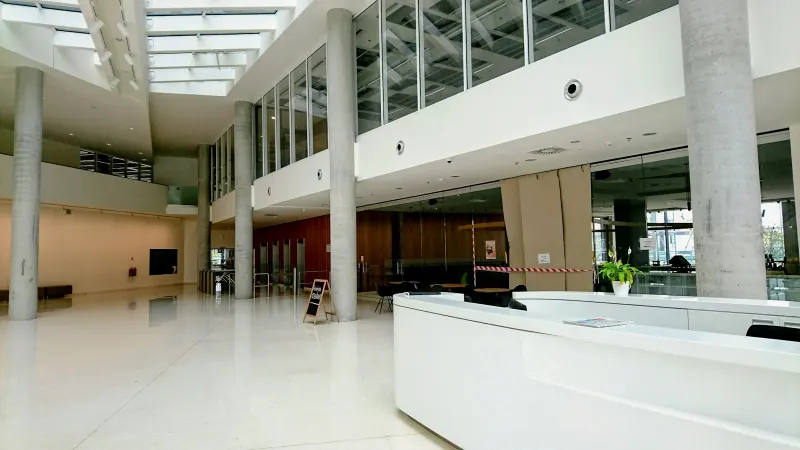
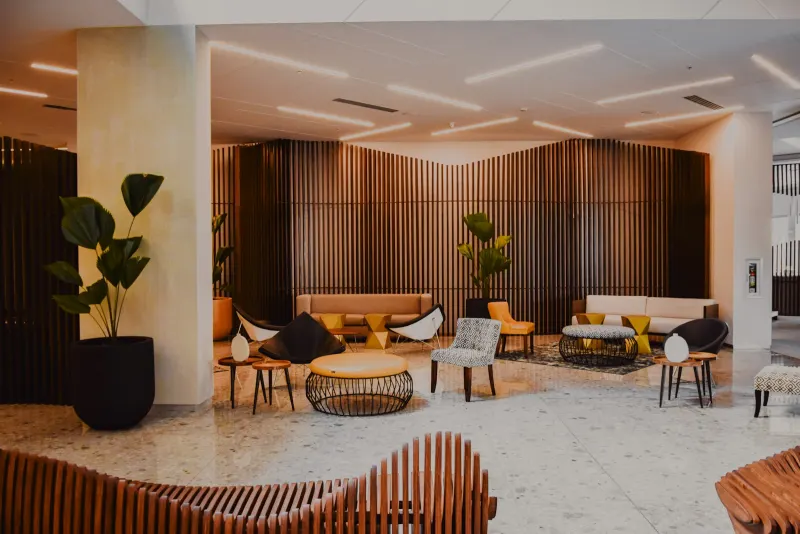
See where you will have your surgery and where you will recover, before you travel.



What you can check before you pay
The hospital
- Accreditation
- JCI-accredited, with the certificate number given to you in writing before any deposit.
- Licence
- Turkish Ministry of Health licence, named and verifiable independently rather than described in general terms.
- Intensive care
- On site, in the same building, for every procedure under general anaesthetic. Not "available nearby".
- Anaesthesia
- A consultant anaesthetist present throughout the operation — not supervising several theatres from elsewhere.
- Nursing
- 24-hour nursing, with an English-speaking nurse on each shift and an interpreter for clinical conversations.
Photos are not proof
Photographs show you the rooms; they do not tell you whether there is an intensive care unit behind them. The facility is named to you in writing before you pay, with its licence and accreditation numbers, so you can verify it as well as see it.
If you want to see the building in person, ask — we can usually arrange a visit before you decide, and a provider unwilling to let you look around is telling you something.
How we verify a facility



How is chin and jawline surgery performed?
One to two and a half hours under general anaesthetic, almost always through incisions inside the mouth so there is no visible scar.
- 1Imaging review: nerve position, bone thickness and tooth root depth are confirmed on the X-ray or CT before any incision.
- 2Anaesthetic: a consultant anaesthetist puts you to sleep. The mouth is prepared with antiseptic.
- 3Chin implant — access: a small incision inside the lower lip, or occasionally under the chin, exposes the chin bone. A precise pocket is made, no larger than the implant, so it cannot move.
- 4Chin implant — placement: the implant is positioned on the bone, checked for symmetry against the facial midline and fixed with a screw or suture so it cannot migrate.
- 5Sliding genioplasty — the cut: an oscillating saw divides the chin bone horizontally below the tooth roots and below the mental nerve, which is identified and protected first.
- 6Sliding genioplasty — repositioning: the freed segment is slid forward to the planned distance, and can also be moved vertically or asymmetrically to correct a deviation. It is fixed with titanium plates and screws.
- 7Jaw angle implants: placed through intraoral incisions at the back of the mouth, sitting on the angle of the mandible and fixed in position.
- 8Buccal fat removal: a small intraoral incision in the cheek allows the buccal fat pad to be teased out. Conservative removal only — this is not reversible.
- 9Closing: intraoral incisions closed with dissolving sutures and a supportive dressing or chin strap applied.
Chin and jawline recovery timeline
Expect swelling for two to three weeks, soft food for a fortnight, and lower lip numbness that can take weeks to months to resolve fully.
- Days 1–3: swelling across the chin and jaw, often extending to the neck. Numbness of the lower lip and chin is expected. Head elevated, soft food, mouthwash after every meal.
- Days 4–7: swelling peaks around day three or four then begins to settle. Talking is tiring and chewing is uncomfortable.
- Days 10–14: most patients are presentable and back at a desk job. Residual swelling remains obvious to you.
- Weeks 3–4: swelling largely resolved. Normal eating resumes. Numbness beginning to improve.
- Weeks 4–6: light exercise restarts. No contact sport for three months after an implant or genioplasty.
- Months 2–3: the contour becomes clear. Lip sensation continues recovering.
- Months 3–6: the final result. Full sensation usually returns, though a small area of altered feeling can persist.
Is chin and jawline surgery in Turkey safe?
These are well-established operations with low complication rates. The two risks worth understanding are mental nerve injury and, with implants, infection or malposition.
Velsa works only with JCI-accredited private hospitals in Istanbul and with plastic surgeons registered with the Turkish Ministry of Health who hold Turkish Society of Plastic, Reconstructive and Aesthetic Surgeons membership. Facial imaging before surgery is standard rather than optional.
Risks you should know about
- Mental nerve injury: numbness of the lower lip and chin, common temporarily and occasionally permanent.
- Implant infection: uncommon, but usually means removing the implant.
- Implant malposition or migration: prevented by a precise pocket and fixation, but a recognised problem with unfixed implants.
- Bone resorption: the chin bone can thin slightly beneath a long-standing implant. Usually of no consequence.
- Asymmetry: faces are not symmetrical, and small differences often remain or become more noticeable.
- Over-resection in buccal fat removal: faces slim with age, and removing too much can produce a gaunt, hollow look in later decades.
- Infection or plate problems after genioplasty: uncommon, and plates are rarely removed.
- Lip incompetence: difficulty closing the lips comfortably after a large advancement.
Tell your surgeon if you grind your teeth, have had orthodontic treatment, or have any jaw joint problems. All three affect planning, and jaw joint symptoms can be worsened by prolonged mouth opening during surgery.
Your medical team
Meet your chin and jawline contouring team
You meet your specialist in person before treatment, and they follow your recovery until you are fully healed.
Meet the whole teamFree online consultation
Start your chin and jawline contouring journey
- 1Share your detailsFill in the form in under a minute.
- 2Send your photosYour coordinator tells you which photos we need, via WhatsApp or email.
- 3Receive your planA specialist reviews your case and you get a written, all-inclusive quote.
Can chin and jawline surgery be combined with other procedures?
Very commonly with rhinoplasty, because facial balance is about proportion and the nose and chin define the profile together.
A nose that looks too large is sometimes a chin that is too small. Assessing the profile as a whole rather than feature by feature is what separates a balanced result from one that simply moves the problem.
Commonly combined with
- Rhinoplasty: the classic profile pairing, and frequently the combination that produces the change a patient was actually looking for. See rhinoplasty.
- Neck liposuction: removing submental fat sharpens the jawline more than any implant can on its own.
- Buccal fat removal: slims the lower cheek and emphasises the jaw angle.
- Facelift: where jawline softening is from ageing rather than bone structure. See facelift.
- Otoplasty: another proportion operation, easily added. See ear surgery.
If your jawline has softened in your forties or fifties rather than always being soft, an implant is probably the wrong answer. That is jowling and descent, and lifting addresses it where augmentation does not.
How to prepare for chin and jawline surgery
See a dentist first, send a photograph of your bite, stop smoking, and plan a fortnight of soft food.
- Dental check: intraoral incisions mean any active dental infection must be treated first. Have a check-up before you travel.
- Bite photograph: send a photograph of your teeth closed together, front on. It is the quickest way for a surgeon to spot a bite discrepancy that would change the recommendation.
- Try filler first: if you are unsure about a chin implant, chin filler previews the result for a fraction of the cost and dissolves if you dislike it.
- Medication: tell your surgeon everything you take. Blood thinners and anti-inflammatories increase bruising in a highly vascular area.
- Smoking: stop at least four weeks before and after. It raises the risk of implant infection and poor intraoral healing.
- Soft food: plan a fortnight. Soup, eggs, yoghurt, soft fish and smoothies.
- Time off: plan 10–14 days. Facial swelling is visible and chewing is uncomfortable.
Chin and jawline results
Implants and genioplasty both give permanent results. The contour emerges over three to six months as swelling resolves, and the profile change is often more significant than patients expect from a small movement.
A few millimetres of chin projection changes the profile considerably, which cuts both ways: it is why modest surgery achieves so much here, and why over-correction is so visible. A good result balances the chin against the nose and the lips rather than maximising projection, and the test of success is a profile that looks unremarkable rather than one that draws attention to the chin.
Implants are permanent but removable, which is a genuine advantage if you change your mind or if your face changes with age. A sliding genioplasty is permanent and not reversible, but it uses your own bone, carries no infection-around-a-foreign-body risk and can correct vertical position as well as projection. Buccal fat removal is the one procedure here to approach with real caution — faces naturally slim with age, and fat removed at 25 cannot be put back at 50. As consented cases are added, our before and after gallery shows profile comparisons at three and twelve months.
FAQ
Chin and jawline contouring in Turkey: frequently asked questions
At Velsa, £1,800–£2,600 for a chin implant, £2,600–£3,600 for a sliding genioplasty, £2,400–£3,400 for jaw angle implants and £1,400–£1,900 for buccal fat removal, all-inclusive. The UK equivalent is typically £4,000–£9,000.
An implant for a modest 3–7 mm advance in a patient with a normal bite — shorter surgery and reversible. A genioplasty for larger advancement, for correcting vertical height or asymmetry, or for patients who would rather not have a foreign body. Genioplasty is more surgery and is not reversible.
Usually not. Most chin and jaw procedures are performed through incisions inside the mouth. Occasionally an implant is placed through a small incision under the chin, which heals to a fine line hidden in the shadow beneath the jaw.
To see where the mental nerve runs, how thick the chin bone is and where the tooth roots sit. It also reveals bite discrepancies that would make a chin implant the wrong answer. Planning chin surgery from photographs alone is working blind.
It is a sensible way to preview a stronger chin for £350–£600, lasting nine to eighteen months and dissolvable if you dislike it. Some patients find filler is enough; others find it confirms they want surgery. Both outcomes are useful information.
Almost certainly, temporarily. The mental nerve runs through the surgical field, and stretching it causes numbness in most patients. It typically resolves over six weeks to six months. Permanent numbness is uncommon but possible, particularly after a genioplasty.
Yes, and that reversibility is one of its advantages. Removal is a shorter operation than placement. The chin bone sometimes thins slightly beneath a long-standing implant, which is usually of no consequence.
Then a chin implant is cosmetic camouflage for a structural problem. A receding chin often accompanies a jaw that sits too far back, and orthodontics or jaw surgery addresses the cause. Velsa does not perform jaw repositioning, and we will tell you if that is what you need.
For the right patient, yes — but approach it carefully. Faces slim naturally with age, and fat removed in your twenties cannot be replaced in your fifties. Conservative removal in someone over 25 with genuinely full lower cheeks is reasonable; aggressive removal in a young face frequently ages badly.
In patients with thin facial tissue, large implants can show their edges. Conservative sizing matched to your bone structure looks natural; oversized implants chasing a dramatic jawline do not. Your surgeon should size them against your imaging.
Soft food for about two weeks while the intraoral incisions heal, with antibacterial mouthwash after every meal. Normal eating usually resumes from weeks two to three.
Probably not. If your jawline was once defined and has blurred in your forties or fifties, that is jowling and tissue descent rather than bone structure. A facelift addresses it; augmentation does not.
Medical disclaimer: This page is for general information only and does not replace a consultation with a qualified surgeon. Prices depend on your individual assessment. Every surgery carries risks, and individual results vary.