

What is breast implant revision?
Revision surgery is any second operation on augmented breasts: exchanging implants for a different size or type, removing scar tissue around them, correcting position, or removing them altogether.
Around one in five women with implants needs further surgery within ten years. That is not a sign anything went wrong — implants are devices in living tissue, the body forms a capsule around them, breasts age, and tastes change. Planning for the possibility from the outset is more realistic than treating revision as a failure.
Why patients come back
| Problem | What it is | Usual revision |
|---|---|---|
| Capsular contracture | Scar tissue tightening around the implant | Capsulectomy plus implant exchange |
| Implant rupture | Shell failure, often silent | Removal and exchange |
| Malposition | Implant sitting too high, low or lateral | Capsulorrhaphy or pocket change |
| Rippling | Visible edges in thin tissue | Exchange plus fat grafting or plane change |
| Size change | Wanting larger, smaller or out | Exchange or explant |
| Sagging around the implant | Breast tissue dropping over time | Exchange with a lift |
| Symmastia | Pockets meeting in the midline | Capsulorrhaphy, a difficult repair |
Capsular contracture
Every implant is surrounded by a capsule of scar tissue — that is normal and usually imperceptible. In roughly one in twenty patients the capsule tightens, squeezing the implant into a ball, making the breast firm, higher and eventually painful. It is graded I to IV, and from grade III onward surgery is the only effective treatment. Removing the capsule entirely at the same time as exchanging the implant gives the lowest recurrence rate.
The three implant planes
Over the muscle
Quicker recovery, but the edge can show through thin tissue
Under the muscle
More natural upper slope and better coverage, with a longer recovery
Dual plane
Muscle covers the top, tissue the bottom — the usual choice
How much does breast implant revision cost in Turkey?
A Velsa all-inclusive revision package in Istanbul costs £2,900–£4,600 depending on what is needed. The same surgery privately in the UK is typically £7,000–£12,000.
| Procedure | Price (GBP) | Hospital nights | Nights in Turkey |
|---|---|---|---|
| Implant exchange, same pocket | £2,900–£3,400 | 1 | 7 |
| Exchange with capsulectomy | £3,400–£4,100 | 1–2 | 8 |
| Explant with total capsulectomy | £3,200–£3,900 | 1–2 | 8 |
| Explant with breast lift | £3,900–£4,600 | 1–2 | 8 |
| Exchange with lift | £4,000–£4,600 | 1–2 | 8 |
| Exchange with fat grafting | £3,800–£4,500 | 1–2 | 8 |
What the package includes
- Surgeon and anaesthetist fees
- One to two nights in a private hospital room
- Pre-operative ultrasound or MRI where rupture is suspected
- New implants with international warranty, where exchanged
- Histology on removed capsule tissue
- Seven nights in a four-star hotel with breakfast
- All airport, hotel and hospital transfers
- A personal English-speaking coordinator
- Post-operative surgical bra and medication
- Twelve months of remote aftercare
Why we ask for your original records
Implant size, type, manufacturer, pocket plane and the incision used all change the plan. If you have your implant card, send it. If you do not, an ultrasound or MRI in Istanbul will tell us a good deal — but knowing what is in there before you travel means a more accurate quote and fewer surprises.
What it costs elsewhere
£2,900–£4,600
All-inclusive with Velsa: surgeon, hospital, hotel, transfers and twelve months of aftercare
£12,500+
Typical saving against the UK, mid-range against mid-range, before flights
77%
Less than the typical UK price
Bars span the usual range in each market, not a single quoted figure. Non-Turkish figures are indicative market ranges rather than quotes from named providers.
US and UK figures are typically the surgeon and facility only. Flights, accommodation, transfers and follow-up are extra in those markets and included in the Velsa price, which is the comparison that actually matters.
Your own price comes from a written quote after a clinician has reviewed your case. Nothing on this chart is a quote.
Why do patients from the UK, US and Europe choose Turkey?
Patients choose Turkey for lower all-inclusive prices, experienced plastic surgeons who operate at high volume, modern private hospitals, short waiting times and easy direct flights from most European and many US cities.
Turkey has become one of the world's leading medical travel destinations. According to Turkish industry figures reported in July 2026, the country welcomed around 1.4 million health tourists in 2025, generating over $3 billion in revenue. Aesthetic surgery is one of the most requested categories.
- Value: lower operating and living costs mean you pay less for the same type of surgery and hospital care.
- Experience: leading surgeons in Istanbul and other major cities perform aesthetic operations every week.
- Speed: consultations can be arranged online within days, and surgery dates are flexible.
- Access: most UK and European airports have direct flights of around 3–4 hours.
- Recovery comfort: you recover in a hotel with a coordinator on hand, rather than managing alone at home.
Every Velsa quote names the surgeon and the hospital before you pay, so you can check both yourself.
Am I a good candidate for revision surgery?
Revision suits patients with a defined problem — contracture, rupture, malposition — or a settled wish to change size or remove implants, with realistic expectations about what second surgery achieves.
Revision is usually appropriate if
- One or both breasts have become firm, high or painful — grade III or IV capsular contracture.
- An implant has ruptured, or a scan suggests it may have.
- An implant sits too high, too low or has moved outward.
- You can see or feel rippling, particularly in the upper pole.
- Your breasts have dropped around the implants over the years.
- You want your implants removed, with or without a lift.
You may need to think further, or wait
- Your surgery was less than twelve months ago: implants settle for a full year, and revising early often means revising twice.
- You want explant and expect your original breast back: the skin has stretched, and a lift is usually needed to get a satisfying result.
- You smoke: revision surgery in thinner, previously operated tissue is far less forgiving of poor blood supply.
- You have an untreated breast lump or an unresolved mammogram finding.
- You are breastfeeding, or within six months of stopping.
- You are chasing a size that your tissue cannot support: repeated upsizing thins tissue and causes the problems you will be back for.
Our self-check below gives you a starting answer, and a Velsa plastic surgeon reviews your photographs and any scans free of charge before you commit to anything.
1-minute self-check
Do I need implant revision?
Answer 6 quick questions to see whether revision is likely to be the right answer. No personal details needed to see your result.
Your revision journey in Turkey, day by day
Eight nights in Istanbul — two more than primary augmentation, because revision has a higher complication rate and deserves a longer watch.
- 1Before you travel: you send photographs, your original implant card or operation note if you have it, and any recent ultrasound or MRI. A plastic surgeon assesses the problem and sets out the options. You receive a written fixed quote with the likely plan and the contingencies.
- 2Day 1 — arrival: your driver meets you at Istanbul airport and takes you to the hotel.
- 3Day 2 — assessment: blood tests, ECG and an ultrasound or MRI if rupture is suspected. A face-to-face consultation where the plan is confirmed against what the imaging shows, and the markings drawn with you standing.
- 4Day 3 — surgery: two to four hours depending on what is needed. Capsulectomy adds significant time to an exchange. You wake with a surgical bra and sometimes drains.
- 5Day 4 — discharge: drains monitored or removed, wounds checked, and you move to the hotel.
- 6Days 5–7 — hotel recovery: gentle walking, surgical bra day and night, no lifting above shoulder height. Daily coordinator contact.
- 7Day 8 — final check: wounds inspected, implant position assessed with you upright, and your surgeon confirms you are fit to fly. You receive your new implant passport.
- 8Day 9 — fly home with written aftercare and your histology arrangements.
- 9After you are home: nurse check-ins at one week, six weeks, three months and twelve months.
Where you will be cared for
Our partner hospital and hotel
See where you will have your surgery and where you will recover, before you travel.


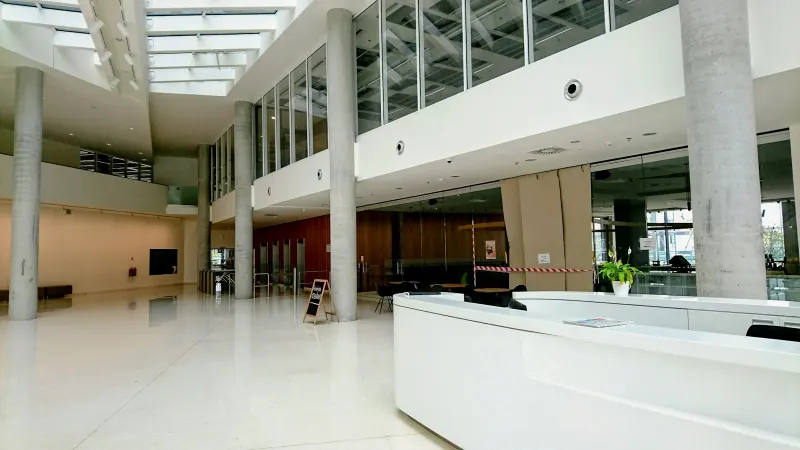

What you can check before you pay
The hospital
- Accreditation
- JCI-accredited, with the certificate number given to you in writing before any deposit.
- Licence
- Turkish Ministry of Health licence, named and verifiable independently rather than described in general terms.
- Intensive care
- On site, in the same building, for every procedure under general anaesthetic. Not "available nearby".
- Anaesthesia
- A consultant anaesthetist present throughout the operation — not supervising several theatres from elsewhere.
- Nursing
- 24-hour nursing, with an English-speaking nurse on each shift and an interpreter for clinical conversations.
Photos are not proof
Photographs show you the rooms; they do not tell you whether there is an intensive care unit behind them. The facility is named to you in writing before you pay, with its licence and accreditation numbers, so you can verify it as well as see it.
If you want to see the building in person, ask — we can usually arrange a visit before you decide, and a provider unwilling to let you look around is telling you something.
How we verify a facility




How is breast implant revision performed?
Two to four hours under general anaesthetic, usually through your existing scar. What happens inside depends entirely on what is found.
- 1Marking: with you standing, your surgeon marks the existing scar, the pocket boundaries and any planned change in position or lift.
- 2Anaesthetic: a consultant anaesthetist puts you to sleep. You are monitored throughout.
- 3Access: through your existing scar wherever possible, so no new scar is created.
- 4Assessing the capsule and implant: the implant is removed and inspected for rupture, and the capsule assessed for thickness, calcification and contracture. This is the point at which the plan is sometimes adjusted.
- 5Capsulectomy: where there is contracture, the capsule is removed — total capsulectomy where possible, taking the whole scar shell. For a ruptured silicone implant, en bloc removal, taking implant and capsule together intact, is preferred where the anatomy allows.
- 6Correcting the pocket: a pocket that is too large is tightened with internal sutures (capsulorrhaphy); a pocket in the wrong plane may be abandoned and a new one created in front of or behind the muscle.
- 7New implants or none: fresh implants are placed, usually smooth and often in a different plane, with a no-touch technique and funnel insertion. For explant, the pocket is closed and the breast reshaped.
- 8Lift where needed: a mastopexy is added if the skin envelope is too large for the new volume, which is common in both downsizing and explant.
- 9Closing: closed in layers with dissolving sutures, drains placed more often than in primary surgery, and a surgical bra fitted before you wake.
Revision recovery timeline
Expect a slightly longer and more variable recovery than primary augmentation — two to three weeks before a desk job, six weeks before full exercise, and six to twelve months for the final shape.
- Days 1–4: more discomfort than a primary augmentation, particularly after a capsulectomy, which involves considerably more dissection. Drains may stay in a few days.
- Week 1: swelling peaks then settles. Surgical bra day and night. Sleep on your back, slightly propped.
- Weeks 2–3: most patients are back at a desk job and driving. Bruising fades.
- Weeks 4–6: light exercise such as walking and cycling. No chest or shoulder work.
- Weeks 6–8: full exercise with your surgeon's approval.
- Months 3–6: the breast softens and settles. Revised breasts take longer to settle than primary ones because the tissue has been operated on twice.
- Months 6–12: the final shape. Where a lift was combined, scars continue maturing to eighteen months.
Is breast implant revision in Turkey safe?
Revision is safe in experienced hands but carries higher complication rates than primary augmentation, because the tissue has been operated on before.
Velsa refers revisions only to plastic surgeons who perform them regularly, in JCI-accredited private hospitals in Istanbul. All removed capsule tissue is sent for histology as standard, which matters for the small number of cases where something unexpected is found.
Risks you should know about
- Higher complication rate than primary surgery: the defining feature of revision.
- Recurrent capsular contracture: more likely after one episode, and the reason for total capsulectomy and a plane change.
- Haematoma and seroma: more common in revision, and the reason drains are used more often.
- Wound healing problems: thinner, previously operated tissue with reduced blood supply.
- Asymmetry: more common than in primary surgery and harder to correct.
- Rippling or implant visibility: worse where tissue has thinned, sometimes needing fat grafting.
- Nipple sensation changes: a second operation adds a second chance of nerve disturbance.
- Disappointment after explant without a lift: the commonest non-medical problem.
Bring your implant card to every mammogram, and tell the radiographer about both your original surgery and the revision. Imaging after revision is harder to interpret without that history.
Your medical team
Meet your breast implant revision team
You meet your specialist in person before treatment, and they follow your recovery until you are fully healed.
Meet the whole teamFree online consultation
Start your breast implant revision journey
- 1Share your detailsFill in the form in under a minute.
- 2Send your photosYour coordinator tells you which photos we need, via WhatsApp or email.
- 3Receive your planA specialist reviews your case and you get a written, all-inclusive quote.
Can revision be combined with other procedures?
A lift is the most common addition, and in explant and downsizing it is usually essential rather than optional. Fat grafting is the other frequent partner.
The central question in most revisions is whether the skin envelope matches the new volume. If you are removing implants or going smaller, it almost certainly will not, and addressing that at the same time is what produces a result you are happy with.
Commonly combined with
- Breast lift: essential in most explants and downsizes, where the skin has stretched around the old volume. See breast lift.
- Fat grafting: adds soft tissue cover over a new implant in thin patients, reducing rippling, and adds modest volume after explant. See fat transfer.
- Plane change: moving from above to below the muscle, which both treats recurrent contracture and improves upper-pole cover.
- Internal bra or mesh support: in patients with very thin or stretched tissue, an absorbable mesh can support the pocket repair.
Hybrid explant — removing implants and replacing part of the volume with your own fat, with a lift — has become a popular route for patients who want implants out but not a flat result. It is a longer operation and usually needs two fat grafting sessions, but it avoids a foreign body entirely.
How to prepare for revision surgery
Find your implant card, get recent imaging, stop smoking, and think carefully about what you actually want the result to be.
- Implant card or operation note: size, type, manufacturer, plane and incision all change the plan. If you cannot find it, request it from the hospital that operated on you.
- Imaging: an ultrasound or MRI if rupture is suspected. MRI is the most reliable for silent silicone rupture.
- Decide what you want: "smaller", "softer", "them out" and "back to how I was" are different goals needing different operations. Being specific with your surgeon changes the plan.
- Smoking: stop at least four weeks before and after. Revision tissue has reduced blood supply and is far less forgiving.
- Medication: tell your surgeon everything you take, including the combined pill and HRT.
- Breast screening: if you are over 40 or have a family history, have a mammogram or ultrasound before you travel.
- Time off: plan two to three weeks away from work and six weeks away from the gym and heavy lifting.
Revision results and what to expect long term
A well-planned revision resolves the problem that brought you back, but the result is less predictable than primary surgery and the breast will continue to change.
For capsular contracture, total capsulectomy with a new smooth implant in a different plane gives the best recurrence figures, and most patients are permanently rid of the problem. For malposition and rippling, results are good but depend heavily on how much tissue cover remains. For explant, satisfaction is high when a lift was included and noticeably lower when it was not.
The honest long-term framing is that implants are not a one-time decision. A patient who has one revision has a higher chance of needing another, because the factors that caused the first — thin tissue, a large implant relative to the frame, a tendency to form scar tissue — do not disappear. Choosing a size the tissue can genuinely support, rather than the largest that fits, is the single best protection against coming back. As consented cases are added, our before and after gallery shows three and twelve month comparisons.
FAQ
Breast implant revision in Turkey: frequently asked questions
At Velsa, £2,900–£3,400 for a straightforward exchange, £3,400–£4,100 with capsulectomy, and £3,900–£4,600 where a lift is combined. That covers the surgeon, anaesthetist, hospital nights, imaging, new implants where exchanged, six to seven hotel nights and twelve months of aftercare.
It takes longer and is technically harder. Capsulectomy in particular adds substantial time, there is scar tissue instead of clean planes, drains are used more often and the hospital stay is longer. It is a bigger operation, not a repeat of a smaller one.
The breast becomes firm, sits higher, changes shape and may become painful. It is graded I to IV — grade I is normal and imperceptible, grade IV is hard, distorted and painful. From grade III onward, surgery is the only effective treatment.
Often you do not — silicone rupture is frequently silent. A saline implant deflates obviously. For silicone, ultrasound or MRI is needed, and MRI is the most reliable. UK guidance suggests periodic scanning of silicone implants for this reason.
Removing the implant and the surrounding capsule together as a single intact unit, without opening the capsule. It is preferred where a silicone implant has ruptured, so no silicone escapes into the tissue, and where the anatomy allows it safely.
Almost certainly not. The skin has stretched to accommodate the implant, and removing it leaves a breast that is flatter, emptier and lower than your original. A lift at the same time, or fat grafting, is usually what produces a result patients are happy with.
Most patients do, particularly if implants have been in for several years or were large. Your surgeon will assess your skin envelope and nipple position from photographs. Explant without a lift is appropriate in a minority — usually small implants, in for a short time, in young skin.
Some women report fatigue, joint pain, brain fog and other systemic symptoms they attribute to their implants. It is not a recognised medical diagnosis, the evidence is unsettled, and a proportion of women report improvement after explant. We will not dismiss your symptoms, and we will not promise explant will resolve them.
A rare lymphoma associated almost exclusively with textured implants, usually presenting as swelling of the breast years after surgery. It is treated by complete removal of the implant and capsule and is generally curable when caught early. Velsa uses smooth implants.
Because revision has a higher complication rate than primary surgery — more haematoma, more seroma, slower wound healing in previously operated tissue. The extra nights keep you in Istanbul longer during the window when those appear.
Yes, and downsizing is common. Be aware the skin envelope will be too large for the smaller volume, so a lift is frequently needed at the same time — otherwise the result is a smaller but looser breast.
Possibly. Having one revision raises the likelihood of another, because the underlying factors — thin tissue, a large implant relative to your frame, a tendency to form scar tissue — persist. Choosing a size your tissue can genuinely support is the best protection.
Medical disclaimer: This page is for general information only and does not replace a consultation with a qualified surgeon. Prices depend on your individual assessment. Every surgery carries risks, and individual results vary.