

What is an FUE hair transplant?
Follicular unit extraction removes individual follicular units — natural groupings of one to four hairs — from the donor area at the back and sides of the head using a punch under one millimetre wide, then places them where hair has been lost.
FUE replaced the older strip method, FUT, for most patients because it leaves no linear scar. Instead of removing a band of scalp and closing it with sutures, FUE takes each unit separately, leaving hundreds of dot scars that are invisible at normal hair length. The trade-off is time: extraction takes about three hours rather than thirty minutes.
The technique splits into two halves that matter in different ways. Extraction is largely mechanical and is where graft quality is won or lost — a punch that transects follicles produces grafts that will not grow. Channel opening is where the result is designed: the angle, direction, depth and density of every recipient site determine whether the outcome looks natural or like a doll's head.
FUE against the alternatives
| FUE | Sapphire FUE | DHI | |
|---|---|---|---|
| Channel opening | Steel blade | Sapphire blade | Choi implanter pen |
| Grafts per session | Up to 4,500 | Up to 4,500 | Up to 3,500 |
| Shaving needed | Yes | Yes | Optional |
| Density achievable | High | Highest | High |
| Session length | 6–8 hours | 6–8 hours | 8–10 hours |
| Price | £1,650–£2,100 | £1,900–£2,400 | £2,300–£2,900 |
Our detailed comparison of FUE and DHI sets out which suits which pattern. The short answer: FUE covers more area per session, DHI gives finer control at the hairline.
The three stages of an FUE transplant
Extraction
Follicles taken one at a time from the donor area
Channels
The surgeon opens each site at the natural angle
Growth
Hair grows from month three and matures by 12–18 months
How much does an FUE hair transplant cost in Turkey?
A Velsa all-inclusive FUE package in Istanbul costs £1,650–£2,100 for up to 4,000 grafts. The same procedure in the UK is typically £5,000–£10,000, usually priced per graft.
| Technique | Price (GBP) | Grafts included | Nights in Turkey |
|---|---|---|---|
| FUE | £1,650–£2,100 | Up to 4,000 | 3 |
| Sapphire FUE | £1,900–£2,400 | Up to 4,500 | 3 |
| DHI | £2,300–£2,900 | Up to 3,500 | 3 |
| Unshaven FUE | £2,500–£3,100 | Up to 2,500 | 3 |
| Second session, returning patient | £1,400–£1,800 | Up to 3,000 | 3 |
What the package includes
- Surgeon consultation and hairline design
- The procedure itself, however many grafts you need
- All pre-operative blood tests
- Three nights in a four-star hotel with breakfast
- All airport, hotel and clinic transfers
- A personal English-speaking coordinator
- First wash performed at the clinic, with training
- Aftercare kit: lotion, shampoo, medication
- PRP session where clinically indicated
- Twelve months of remote aftercare and growth reviews
Why Velsa does not charge per graft
Per-graft pricing gives a clinic a financial reason to harvest more than your donor area can afford, and it leaves you with a bill that only becomes clear on the day. Velsa quotes one fixed price for the plan your surgeon recommends. If you need fewer grafts than estimated the price does not change, and neither does it if you need more.
What it costs elsewhere
£1,650–£2,100
All-inclusive with Velsa: surgeon, hospital, hotel, transfers and twelve months of aftercare
£4,800+
Typical saving against the UK, mid-range against mid-range, before flights
72%
Less than the typical UK price
Bars span the usual range in each market, not a single quoted figure. Non-Turkish figures are indicative market ranges rather than quotes from named providers.
US and UK figures are typically the surgeon and facility only. Flights, accommodation, transfers and follow-up are extra in those markets and included in the Velsa price, which is the comparison that actually matters.
Your own price comes from a written quote after a clinician has reviewed your case. Nothing on this chart is a quote.
Why do patients from the UK, US and Europe choose Turkey?
Patients choose Turkey for lower all-inclusive prices, experienced hair restoration teams who perform transplants every day, modern private clinics, short waiting times and easy direct flights from most European and many US cities.
Turkey has become one of the world's leading medical travel destinations. According to Turkish industry figures reported in July 2026, the country welcomed around 1.4 million health tourists in 2025, generating over $3 billion in revenue. Hair transplantation is the treatment Turkey is best known for.
- Value: lower operating and living costs mean you pay less for the same standard of treatment.
- Experience: leading clinics in Istanbul perform hair transplants every day.
- Speed: consultations can be arranged online within days, and treatment dates are flexible.
- Access: most UK and European airports have direct flights of around 3–4 hours.
- Recovery comfort: you recover in a hotel with a coordinator on hand, rather than managing alone at home.
Every Velsa quote names the surgeon who will design your hairline and the clinic where the work is done, before you pay anything.
Am I a good candidate for FUE?
FUE suits most patients with stable male or female pattern loss and a healthy donor area. It is particularly good where a large area needs covering in a single session.
FUE is usually suitable if
- You have classic pattern loss with hair preserved at the back and sides.
- Your loss has been stable for at least a year, or is controlled with medication.
- You need a larger area covered — FUE moves more grafts per session than DHI.
- You are over 25. Transplanting into an aggressive early pattern risks an unnatural result as loss continues around it.
- You are happy to have the donor and recipient areas shaved to about 1 mm.
- Your donor density is good, which your surgeon measures from your photographs.
You may need to wait, or consider something else
- You are under 25 with rapidly advancing loss: medical treatment first usually gives a better long-term result.
- You cannot have your head shaved: consider unshaven FUE, which costs more and covers less.
- Your loss is diffuse and affects the donor area too, which can indicate a cause other than pattern baldness.
- You have untreated alopecia areata or an active scalp condition.
- You only need a small, precise hairline refinement, where DHI gives finer control.
- You expect the density of teenage hair. FUE achieves 40–50 follicular units per square centimetre — convincing coverage, not original density.
Our hair graft calculator and the Norwood scale tool both give you an estimate in about a minute, and a surgeon confirms it from your photographs free of charge.
1-minute self-check
Am I a good candidate for FUE?
Answer 6 quick questions to see if an FUE hair transplant could be right for you. No personal details needed to see your result.
Your FUE journey in Turkey, day by day
Three nights in Istanbul and one long day in the clinic.
- 1Before you travel: you send photographs of your hairline, crown and donor area. A surgeon assesses your Norwood stage, donor density and realistic graft count, and you receive a written fixed quote with a hairline plan.
- 2Day 1 — arrival: your driver meets you at Istanbul airport and takes you to the hotel. Nothing medical happens today.
- 3Day 2 — the procedure: blood tests first thing, then your surgeon draws the hairline with you in front of a mirror and you agree it before anything is shaved. Extraction takes about three hours, then lunch, then channel opening and placement. You are back at the hotel by early evening.
- 4Day 3 — first wash: you return to the clinic for your first wash, performed by a nurse who then teaches you to do it yourself. You receive your lotion, shampoo, medication and written instructions, plus a PRP session if indicated.
- 5Day 4 — fly home: a final check and your transfer to the airport. Wear a loose hood rather than a cap.
- 6Days 10–14: crusts clear and the transplanted hairs shed. Expected — the follicle stays and begins a new cycle.
- 7Months 3–4: first new growth, fine and sparse at first.
- 8Months 6–12: thickening continues. Velsa reviews your photographs at 3, 6 and 12 months with your surgeon.
Where you will be cared for
Our partner hospital and hotel
See where you will have your surgery and where you will recover, before you travel.


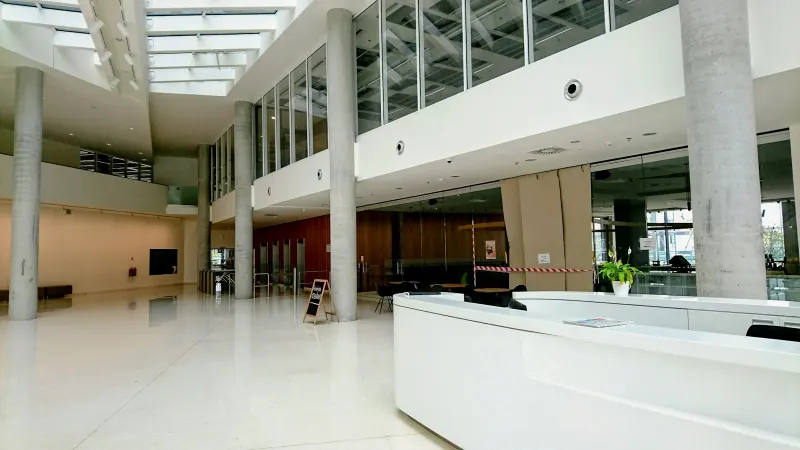

What you can check before you pay
The hospital
- Accreditation
- JCI-accredited, with the certificate number given to you in writing before any deposit.
- Licence
- Turkish Ministry of Health licence, named and verifiable independently rather than described in general terms.
- Intensive care
- On site, in the same building, for every procedure under general anaesthetic. Not "available nearby".
- Anaesthesia
- A consultant anaesthetist present throughout the operation — not supervising several theatres from elsewhere.
- Nursing
- 24-hour nursing, with an English-speaking nurse on each shift and an interpreter for clinical conversations.
Photos are not proof
Photographs show you the rooms; they do not tell you whether there is an intensive care unit behind them. The facility is named to you in writing before you pay, with its licence and accreditation numbers, so you can verify it as well as see it.
If you want to see the building in person, ask — we can usually arrange a visit before you decide, and a provider unwilling to let you look around is telling you something.
How we verify a facility




How is an FUE hair transplant performed?
Six to eight hours under local anaesthetic, in one day. You are awake throughout and can eat, talk and use your phone between stages.
- 1Hairline design: your surgeon draws the new hairline with you sitting upright in front of a mirror, accounting for your facial proportions, your age and how your loss is likely to progress. Nothing starts until you agree it.
- 2Shaving: the donor area and usually the recipient area are shaved to about 1 mm, which makes extraction and placement far more accurate.
- 3Local anaesthetic: injected into the donor area. This is the only genuinely uncomfortable part and lasts a couple of minutes.
- 4Extraction: follicular units are removed one at a time with a 0.7–0.9 mm punch, either manually or with a micromotor. This takes about three hours and produces the day's graft count.
- 5Sorting and storage: grafts are examined under magnification, sorted into singles, doubles and triples, and held in a chilled preservation solution. Time out of the body is the main threat to survival, so sorting is done as extraction continues rather than afterwards.
- 6Opening the channels: the surgeon opens recipient sites with a fine steel blade at the angle, direction and depth that match your natural growth. This step decides more than any other whether the result looks natural.
- 7Placement: grafts are placed into the channels — single-hair units at the hairline for a soft, irregular edge, multi-hair units behind them for density.
- 8Dressing: the donor area is dressed and a headband fitted to control forehead swelling. You return to the hotel the same evening.
FUE recovery timeline
Expect crusting for about ten days, shedding at weeks two to four, first growth at three to four months, and the final result between twelve and eighteen months.
- Days 1–3: tightness in the donor area and forehead swelling, which can reach the eyes around day three. Harmless and settles within 48 hours.
- Days 3–10: you wash daily with the lotion and shampoo provided, softening the crusts. Do not pick them. Sleep propped at 45 degrees.
- Days 10–14: the last crusts come away and the donor area is healed. Most patients are comfortable in public without a hat.
- Weeks 2–4: shock loss — the transplanted hairs shed. This alarms almost everyone and is completely normal: the follicle is intact and entering a resting phase.
- Months 1–3: the "ugly duckling" phase. The scalp looks much as it did before surgery. Nothing is wrong.
- Months 3–4: first new hairs appear, fine and wispy.
- Months 6–9: noticeable density. Hair thickens and takes colour.
- Months 12–18: the final result, with the crown typically the slowest area to fill in.
Is an FUE hair transplant in Turkey safe?
FUE is minor surgery with a low complication rate. The real risk in Turkey is choosing the wrong provider rather than the procedure itself.
Velsa works only with licensed clinics and hospitals in Istanbul, and with doctors registered with the Turkish Ministry of Health. Your surgeon designs the hairline and opens the channels personally. You are given their name and registration number before you pay anything.
Risks you should know about
- Poor growth: usually from grafts being out of the body too long, rough handling, or channels at the wrong depth.
- An unnatural hairline: too straight, too low, or multi-hair grafts placed at the front. A design failure, not bad luck.
- Overharvesting: taking too much donor hair leaves the back of the head visibly thin, and it cannot be undone.
- Shock loss: existing hair around the transplant sheds temporarily, usually regrowing within a few months.
- Folliculitis: small spots around new hairs, common at weeks 4–8 and easily treated.
- Infection: uncommon with proper aftercare, treated with antibiotics.
- Numbness: temporary reduced sensation in the donor area, settling over a few months.
- Dot scarring: tiny circular scars in the donor area, invisible at normal length but visible on a shaved head.
Nothing about FUE is an emergency, which is one reason it travels well. Your coordinator stays reachable and your surgeon reviews photographs at three, six and twelve months.
Your medical team
Meet your FUE hair transplant team
You meet your specialist in person before treatment, and they follow your recovery until you are fully healed.
Meet the whole teamFree online consultation
Start your FUE hair transplant journey
- 1Share your detailsFill in the form in under a minute.
- 2Send your photosYour coordinator tells you which photos we need, via WhatsApp or email.
- 3Receive your planA specialist reviews your case and you get a written, all-inclusive quote.
Can FUE be combined with other treatments?
Yes — and the best long-term results come from combining surgery with medical treatment rather than relying on surgery alone.
Surgery restores what you have lost. Medication protects what you still have. Used together they prevent the common pattern of a good transplant surrounded by continuing loss.
Commonly combined with
- PRP therapy: your own platelet-rich plasma injected into the scalp to support graft survival and strengthen existing hair. Often included in your package. See PRP hair therapy.
- Finasteride and minoxidil: the two treatments with the strongest evidence for slowing pattern loss. Your surgeon will advise whether they suit you.
- Beard or eyebrow transplant: possible in the same trip if your donor area is generous enough.
- DHI at the hairline: some surgeons use DHI for the frontal row and FUE behind it, combining the precision of one with the volume of the other.
A second session is sometimes planned from the outset for extensive loss — typically twelve months after the first, once growth is established and your surgeon can see exactly how much donor hair remains.
How to prepare for your FUE transplant
Stop blood thinners and alcohol before you travel, come with clean unstyled hair, wear a button-up shirt, and plan to protect the grafts for two weeks.
- Medication: tell your surgeon everything you take. Blood thinners, aspirin and some supplements raise bleeding during extraction and may need pausing.
- Alcohol and smoking: no alcohol for 3 days before, and stop nicotine for at least 2 weeks before and after — it reduces blood flow to healing grafts.
- Minoxidil: stop about a week before and restart when your surgeon says so.
- On the day: wash your hair, use no gel or wax, and wear a shirt that buttons at the front so you do not pull anything over your head afterwards.
- Packing list: a loose hoodie, a travel pillow so nothing touches the back of your head on the flight, and your medication in its original packaging.
- Time off: most patients take a week, and plan around two weeks before returning to a workplace where they would rather not explain.
FUE results and scarring
Transplanted hair is permanent and grows for life. The final result appears between twelve and eighteen months, and FUE leaves tiny dot scars invisible at normal hair length.
Judge the result at twelve months, not before. At three months you will see almost nothing; at six you will see enough to be encouraged; at twelve the density is close to final, and the crown may still improve into the eighteenth month. Photographing yourself monthly in the same light is the only reliable way to track progress — day to day it is invisible.
The transplanted hair behaves like donor hair, so it is unaffected by the hormone that causes pattern loss. The hair around it still is. Keeping that hair with medication is what keeps the overall result looking good a decade later. As consented cases are added, our hair transplant before and after gallery shows twelve-month outcomes across Norwood stages.
FAQ
FUE hair transplant in Turkey: frequently asked questions
At Velsa, £1,650–£2,100 all-inclusive for up to 4,000 grafts. That covers the surgeon, the procedure, three hotel nights, all transfers, your aftercare kit and twelve months of growth reviews. Flights are not included.
Three nights. Arrival day, procedure day, and a third day for your first wash and aftercare training at the clinic before you fly home on day four.
The local anaesthetic injections sting for a couple of minutes. After that you should feel pressure but not pain. Most discomfort comes afterwards in the donor area, managed with simple painkillers for two or three nights.
FUE covers more area per session and costs less, which suits larger patterns. DHI gives finer control at the hairline and can be done without full shaving, but takes longer and moves fewer grafts. Your surgeon should recommend based on your pattern, not on price.
The same technique with channels opened by a sapphire-tipped blade rather than steel. The finer, smoother channel allows slightly denser packing and tends to mean less crusting and faster healing. See Sapphire FUE.
Hundreds of tiny circular dot scars in the donor area, each under a millimetre. They are invisible at normal hair length and become visible only if you shave your head to the skin. There is no linear scar, which is FUE's main advantage over the older strip technique.
Up to about 4,000–4,500 with FUE, depending on your donor density. More than that in one sitting usually means harvesting more than the scalp can afford, and a clinic promising 6,000 grafts in a day is describing a harvest most donor areas cannot sustain.
For standard FUE, yes, to about 1 mm. Unshaven FUE is possible, costs more and is limited to smaller graft numbers. See unshaven hair transplant.
The transplanted hairs shed at weeks two to four, which is normal. First new growth appears at three to four months, real density by six to nine, and the final result between twelve and eighteen months. The crown is always slowest.
Yes, unless you treat it. Transplanted hair is permanent, but the untransplanted hair around it carries on thinning. This is why most surgeons recommend finasteride or minoxidil alongside surgery.
Many patients with Norwood 5 or above do, usually twelve months later once growth is established. Planning that from the start protects your donor area rather than exhausting it in one sitting.
Contact your coordinator. Growth is assessed at twelve months, because earlier judgements are unreliable. Where there is genuine poor growth attributable to the procedure, Velsa arranges a corrective session under the aftercare terms in your written quote.
Medical disclaimer: This page is for general information only and does not replace a consultation with a qualified surgeon. Prices depend on your individual assessment. Every surgery carries risks, and individual results vary.