

What is fat transfer?
Fat transfer — also called lipofilling or fat grafting — removes fat from an area where you have too much, processes it to isolate viable fat cells, and injects it into an area where volume is missing.
The attraction is that it uses your own tissue. There is no implant, no foreign material, nothing to replace in fifteen years and no risk of allergic reaction. Where fat survives, it survives permanently and behaves like the fat it came from.
The constraint is that fat is living tissue with no blood supply of its own when it arrives. It survives by diffusion from the surrounding tissue until new vessels grow in, and any graft more than a few millimetres from a blood supply dies. This is why technique — many fine passes rather than large deposits — determines the result far more than the volume injected.
Where fat transfer works, and how well
| Area | Typical survival | Volume used | Second session? |
|---|---|---|---|
| Face (cheeks, temples, tear trough) | 50–70% | 10–40 ml | Often |
| Breast | 50–70% | 150–300 ml per side | Commonly |
| Buttocks (BBL) | 60–80% | 400–800 ml per side | Sometimes |
| Hands | 40–60% | 10–20 ml per hand | Often |
| Scars and contour defects | 40–60% | Varies | Often |
Facial fat transfer has lower survival than buttock grafting, mostly because the volumes are smaller and the movement of facial muscles disrupts early grafts. That is not a reason to avoid it — it is a reason to plan for a second session rather than being disappointed by one.
How fat is moved, and how much survives
Harvest
Fat taken gently by liposuction, so the cells survive the move
Prepare
Spun or filtered to separate fat from fluid and oil
Place
In many thin passes, so each parcel finds a blood supply. 50–70% survives
How much does fat transfer cost in Turkey?
A Velsa all-inclusive fat transfer package in Istanbul costs £1,800–£3,300 for the face, breasts or hands; buttock grafting is priced as a BBL, at £3,200–£4,400. The UK equivalent is typically £3,500–£8,000.
| Area | Price (GBP) | Hospital nights | Nights in Turkey |
|---|---|---|---|
| Facial fat transfer | £1,800–£2,400 | Day case | 5 |
| Breast fat transfer, both sides | £2,600–£3,300 | 1 | 6 |
| Hand rejuvenation | £1,800–£2,200 | Day case | 5 |
| Buttock fat transfer (BBL) | £3,200–£4,400 | 1–2 | 8 |
| Second session, returning patient | £1,400–£2,200 | Day case | 4 |
What the package includes
- Surgeon and anaesthetist fees
- Liposuction of the donor area
- Fat processing and purification
- All pre-operative blood tests
- Four to five nights in a four-star hotel with breakfast
- All airport, hotel and hospital transfers
- A personal English-speaking coordinator
- Compression garment for the donor area
- Follow-up appointment before you fly home
- Twelve months of remote aftercare
Budget for a second session
We would rather you planned for it than hoped against it. Roughly half of facial fat transfer patients and a meaningful proportion of breast fat transfer patients have a second session at six to twelve months. Velsa prices returning-patient sessions lower, because the assessment work is already done — but the flights are not.
What it costs elsewhere
£1,800–£3,300
All-inclusive with Velsa: surgeon, hospital, hotel, transfers and twelve months of aftercare
£3,600+
Typical saving against the UK, mid-range against mid-range, before flights
59%
Less than the typical UK price
Bars span the usual range in each market, not a single quoted figure. Non-Turkish figures are indicative market ranges rather than quotes from named providers.
US and UK figures are typically the surgeon and facility only. Flights, accommodation, transfers and follow-up are extra in those markets and included in the Velsa price, which is the comparison that actually matters.
Your own price comes from a written quote after a clinician has reviewed your case. Nothing on this chart is a quote.
Why do patients from the UK, US and Europe choose Turkey?
Patients choose Turkey for lower all-inclusive prices, experienced plastic surgeons who operate at high volume, modern private hospitals, short waiting times and easy direct flights from most European and many US cities.
Turkey has become one of the world's leading medical travel destinations. According to Turkish industry figures reported in July 2026, the country welcomed around 1.4 million health tourists in 2025, generating over $3 billion in revenue. Aesthetic surgery is one of the most requested categories.
- Value: lower operating and living costs mean you pay less for the same type of surgery and hospital care.
- Experience: leading surgeons in Istanbul and other major cities perform aesthetic operations every week.
- Speed: consultations can be arranged online within days, and surgery dates are flexible.
- Access: most UK and European airports have direct flights of around 3–4 hours.
- Recovery comfort: you recover in a hotel with a coordinator on hand, rather than managing alone at home.
Every Velsa quote names the surgeon and the hospital before you pay, so you can check both yourself.
Am I a good candidate for fat transfer?
The best candidates have enough donor fat to harvest, a stable weight, and realistic expectations about survival and the likelihood of a second session.
Fat transfer is usually suitable if
- You have lost facial volume with age and want a natural, permanent restoration.
- You want a modest breast increase — half a cup to one cup — without an implant.
- You have hollow or contoured areas from injury, previous surgery or liposuction.
- You have enough donor fat on the abdomen, flanks or thighs.
- Your weight has been stable for at least six months.
- You are a non-smoker, or can stop at least four weeks before surgery.
You may need something else
- You are very lean: without donor fat there is nothing to transfer.
- You want a substantial breast increase: fat transfer gives half a cup to one cup, not two or three. An implant is the honest answer.
- You want a reversible or adjustable result: fillers can be dissolved, fat cannot be removed easily.
- You are actively losing weight: transferred fat shrinks along with the rest.
- You smoke: nicotine directly reduces graft survival.
- You want one procedure and one result with no possibility of a top-up.
Our self-check below gives you a starting answer, and a Velsa plastic surgeon reviews your photographs free of charge before you commit to anything.
1-minute self-check
Am I a good candidate for fat transfer?
Answer 6 quick questions to see if fat transfer could be right for you. No personal details needed to see your result.
Your fat transfer journey in Turkey, day by day
Five to six nights in Istanbul, depending on whether the procedure is a day case or needs a hospital night.
- 1Before you travel: you send photographs of the target area and the likely donor sites. A plastic surgeon assesses donor fat availability, recommends volumes and tells you how likely a second session is. You receive a written fixed quote.
- 2Day 1 — arrival: your driver meets you at Istanbul airport and takes you to the hotel.
- 3Day 2 — consultation and surgery: blood tests and a face-to-face consultation where donor and recipient areas are marked with you standing or sitting. Surgery the same afternoon, taking one and a half to three hours.
- 4Day 3 — review: swelling peaks, particularly in facial transfer where it can be marked. Your surgeon checks the donor site and the grafted area.
- 5Days 4–5 — rest: compression garment on the donor area, gentle walking, no pressure on the grafted site.
- 6Day 5 or 6 — final check: your surgeon confirms you are fit to fly and gives written aftercare, including how to protect the graft.
- 7Day 6 or 7 — fly home.
- 8Months 3–6: reabsorption settles and the final volume becomes clear.
- 9Months 6–12: your surgeon reviews photographs and advises whether a second session would add worthwhile volume.
Where you will be cared for
Our partner hospital and hotel
See where you will have your surgery and where you will recover, before you travel.


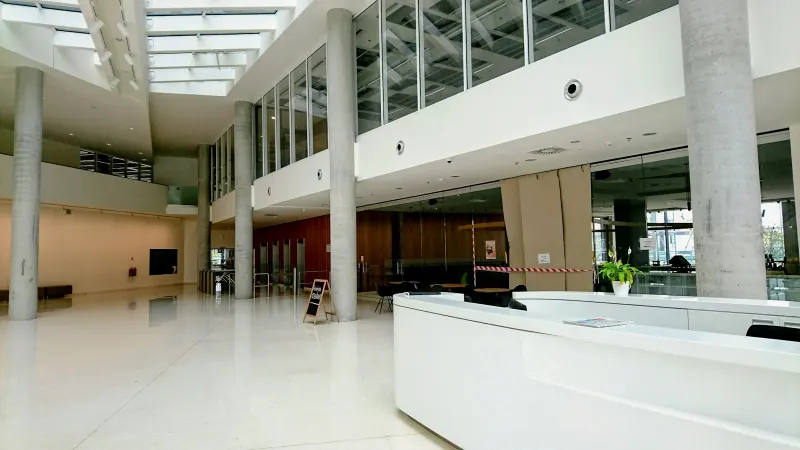

What you can check before you pay
The hospital
- Accreditation
- JCI-accredited, with the certificate number given to you in writing before any deposit.
- Licence
- Turkish Ministry of Health licence, named and verifiable independently rather than described in general terms.
- Intensive care
- On site, in the same building, for every procedure under general anaesthetic. Not "available nearby".
- Anaesthesia
- A consultant anaesthetist present throughout the operation — not supervising several theatres from elsewhere.
- Nursing
- 24-hour nursing, with an English-speaking nurse on each shift and an interpreter for clinical conversations.
Photos are not proof
Photographs show you the rooms; they do not tell you whether there is an intensive care unit behind them. The facility is named to you in writing before you pay, with its licence and accreditation numbers, so you can verify it as well as see it.
If you want to see the building in person, ask — we can usually arrange a visit before you decide, and a provider unwilling to let you look around is telling you something.
How we verify a facility




How is fat transfer performed?
Harvest, process, inject. The care taken at each stage determines how much fat survives, and gentleness matters more than speed.
- 1Marking: donor and recipient areas are marked with you upright, since fat and soft tissue move when you lie down.
- 2Anaesthetic: general anaesthetic for larger volumes, or local with sedation for facial and hand transfer.
- 3Harvesting: fat is removed with low-pressure liposuction through small incisions, using a fine cannula. High suction pressure ruptures fat cells, so gentle harvesting directly improves survival.
- 4Processing: the aspirate is purified by decantation, centrifugation or filtration to separate viable fat from blood, oil and anaesthetic fluid. Typically only 50–70% of what comes out is usable graft.
- 5Preparing for injection: the purified fat is transferred into small syringes — usually 1 ml for facial work, larger for body.
- 6Injection in fine passes: fat is deposited in many thin threads rather than large boluses, with the cannula moving continuously. Every deposit must be within a few millimetres of a blood supply or it will die.
- 7Layering: for facial work, fat is placed at several depths — deep for structural support over bone, superficial for fine contour.
- 8Over-correction: the area is deliberately filled slightly beyond the target to allow for the fat that will not survive.
- 9Closing: tiny incisions closed with a single suture or steristrip. A compression garment is fitted on the donor area.
Fat transfer recovery timeline
Swelling is the limiting factor, not pain. Expect marked swelling for a week to ten days, and the final volume at six months once reabsorption has settled.
- Days 1–3: swelling and bruising in both the donor and recipient areas. Facial transfer swells more visibly than most patients expect.
- Days 3–7: swelling peaks then begins to settle. The donor area feels bruised and tender. Compression garment worn constantly.
- Days 7–10: most patients are presentable and back at a desk job. Residual swelling remains.
- Weeks 2–4: swelling continues resolving. The grafted area looks fuller than the final result will be.
- Weeks 4–6: light exercise can restart. Compression on the donor area continues for six weeks.
- Months 1–3: reabsorption. The grafted volume reduces noticeably, which is expected and not a failure.
- Months 3–6: the volume stabilises. What remains at six months is permanent.
- Months 6–12: your surgeon assesses whether a second session would be worthwhile.
Is fat transfer safe?
Fat transfer uses your own tissue, so there is no rejection or allergy risk. The complications are local — fat necrosis, cysts, irregularity — except in buttock grafting, which carries its own serious risk.
Velsa works only with JCI-accredited private hospitals in Istanbul and with plastic surgeons registered with the Turkish Ministry of Health who hold Turkish Society of Plastic, Reconstructive and Aesthetic Surgeons membership.
Risks you should know about
- Unpredictable survival: typically 50–70% in the face and breast, and it varies between patients.
- Fat necrosis: grafted fat that dies and forms firm lumps. Usually softens over months; occasionally needs removing.
- Oil cysts: smooth fluid-filled lumps where fat has broken down, sometimes needing drainage.
- Calcification: in breast fat transfer, areas of calcification can appear on mammograms and must be distinguished from other causes.
- Contour irregularity: at the donor site more often than the recipient site.
- Asymmetry: fat does not survive equally on both sides.
- Infection: uncommon, but a large graft volume raises the risk relative to simple liposuction.
- Need for a second session: common rather than a complication, but it is a cost and a trip.
If you are having breast fat transfer, tell your radiographer at your next mammogram. Fat grafting produces changes on imaging that a radiologist can interpret correctly if they know the history, and that cause unnecessary alarm if they do not.
Your medical team
Meet your fat transfer team
You meet your specialist in person before treatment, and they follow your recovery until you are fully healed.
Meet the whole teamFree online consultation
Start your fat transfer journey
- 1Share your detailsFill in the form in under a minute.
- 2Send your photosYour coordinator tells you which photos we need, via WhatsApp or email.
- 3Receive your planA specialist reviews your case and you get a written, all-inclusive quote.
Can fat transfer be combined with other procedures?
It is almost always combined with something, because the liposuction needed to harvest the fat improves the donor area at the same time.
Fat transfer is two procedures by definition — liposuction and grafting — so the donor area is being contoured whether that was your goal or not. Many patients choose donor sites for the shaping benefit as much as for the fat yield.
Commonly combined with
- Liposuction: inherent to the procedure. Choosing abdomen, flanks or thighs as donor sites reshapes them at the same time. See Vaser liposuction.
- Facelift: fat transfer restores the volume a facelift cannot, and the two together usually look better than either alone. See facelift.
- Breast augmentation: hybrid augmentation uses an implant for volume and a layer of fat over it to soften the edges, which suits slim patients with little natural tissue.
- Breast lift: fat transfer adds modest upper-pole fullness that a lift alone cannot.
- Eyelid surgery: grafting into the tear trough and temple addresses hollowing that blepharoplasty does not.
Facial fat transfer alongside a facelift is one of the most worthwhile combinations in aesthetic surgery. A facelift repositions tissue; it does not replace lost volume, and a face that has been lifted but not refilled can look tight rather than younger.
How to prepare for fat transfer
Stop smoking, reach a stable weight, do not start a diet before surgery, and plan for the possibility of a second session.
- Smoking: stop at least four weeks before and after. Nicotine constricts the small vessels that must grow into the graft, and it directly reduces how much survives.
- Weight: reach a weight you can maintain, and do not diet in the weeks before surgery — you need the donor fat, and losing weight afterwards shrinks the graft.
- Medication: tell your surgeon everything you take. Blood thinners, anti-inflammatories and some supplements may need pausing.
- Expectations: agree with your surgeon in advance what a realistic single-session result looks like, and whether a second session is likely.
- Time off: plan 7–10 days. Swelling rather than pain is what keeps people at home, particularly after facial transfer.
- Packing list: a compression garment for the donor area, loose clothing, and your medication in its original packaging.
Fat transfer results and survival
What survives at six months is permanent. Typically 50–70% of the injected volume in the face and breast, and 60–80% in the buttocks, with the rest reabsorbed over three to six months.
The emotional arc of fat transfer catches people out. At two weeks the area is swollen and looks over-filled. At six weeks the swelling has gone but the graft is still reabsorbing, and many patients feel the result is disappearing. At three to six months it stabilises, and what is left is yours permanently. Judging it at six weeks is the commonest source of unnecessary worry.
Because surviving fat establishes its own blood supply and behaves like the tissue it came from, it responds to your weight. Significant weight gain enlarges a grafted area, weight loss shrinks it. Patients who reached a stable weight before surgery, protected the graft from pressure in the first three weeks and did not smoke keep the most. As consented cases are added, our before and after gallery shows three and twelve month comparisons.
FAQ
Fat transfer in Turkey: frequently asked questions
At Velsa, £1,800–£2,400 for facial transfer, £2,600–£3,300 for breast and £3,200–£4,400 for buttock grafting, all-inclusive. That covers the surgeon, liposuction, fat processing, hotel, transfers and twelve months of aftercare. Flights are not included.
Typically 50–70% in the face and breast, and 60–80% in the buttocks. The rest is reabsorbed over three to six months. What remains at six months is permanent.
Often, particularly for facial and breast transfer. Roughly half of facial patients have one at six to twelve months. Two modest sessions almost always give a better result than one aggressive one, because over-injecting increases fat necrosis.
Different. Fillers cost less, take twenty minutes and can be dissolved. Fat transfer involves surgery and costs more, but what survives is permanent and it is your own tissue. Permanence is an advantage if you like the result and a problem if you do not.
Half a cup to one cup per session, realistically. If you want two or three cup sizes, an implant is the honest answer — and a hybrid approach using an implant with a layer of fat over it is often the best of both.
Possibly. There must be enough donor fat to harvest, and very lean patients sometimes cannot supply enough. Your surgeon will tell you from your photographs whether there is a workable donor site.
Yes. Surviving fat cells behave like the fat they came from, so a grafted area grows and shrinks with your weight. This is why reaching a stable weight before surgery matters.
Because some of it is. Swelling masks reabsorption initially, and at six weeks many patients feel the volume is going. It stabilises at three to six months, and judging the result earlier causes a lot of unnecessary worry.
It can produce calcifications and oil cysts visible on imaging. These are recognisable to a radiologist who knows you have had fat grafting, so always tell your radiographer. It does not prevent screening or make it unreliable.
No, and this is important. Buttock grafting has historically carried the highest mortality of any cosmetic procedure because of the risk of fat embolism. Face, breast and hand grafting do not carry that risk. Read our BBL page if that is what you are considering.
Light exercise at four weeks, full exercise at six, with your surgeon's approval. More importantly, avoid pressure on the grafted area for the first three weeks — that is what determines survival.
Yes, and it is one of the most worthwhile combinations in aesthetic surgery. A facelift repositions tissue but does not replace lost volume, and a face lifted without being refilled can look tight rather than younger.
Medical disclaimer: This page is for general information only and does not replace a consultation with a qualified surgeon. Prices depend on your individual assessment. Every surgery carries risks, and individual results vary.