

What is All-on-4?
All-on-4 is a technique for replacing an entire arch of teeth with a single fixed bridge supported by four implants — two placed vertically at the front and two angled backwards to reach denser bone.
The angled implants are the whole idea. In a jaw that has lost bone at the back, placing implants straight down there is impossible without grafting. Tilting the rear implants forward lets them engage the stronger bone at the front of the jaw while still emerging far enough back to support a bridge of ten to twelve teeth. That is how a technique that would otherwise need bone grafting and eight implants gets done with four.
Because the four implants are splinted together by a rigid bridge, they share load in a way individual implants do not. That is what allows a temporary fixed bridge to be attached on the day of surgery, long before each implant could carry a tooth on its own.
All-on-4, All-on-6 or individual implants?
| Option | Implants per arch | Bone grafting | Price per arch |
|---|---|---|---|
| All-on-4 | 4 | Usually avoided | £3,200–£4,800 |
| All-on-6 | 6 | Sometimes needed | £4,200–£6,200 |
| Individual implants | 8–10 | Often needed | £4,000–£6,500 |
| Removable denture | 0 | None | £400–£900 |
All-on-6 spreads the load across more implants and is generally preferred where bone quality is good and the budget allows, particularly in the upper jaw where bone is softer. See All-on-6 for the comparison in detail.
All-on-4 compared with the alternatives
Single implant
A titanium post replaces one root, without touching the teeth beside it
All-on-4
Four implants, two of them angled, carry a full arch
All-on-6
Six implants spread the load — used where the bone allows it
How much does All-on-4 cost in Turkey?
A Velsa All-on-4 arch costs £3,200–£4,800 all-inclusive, covering both trips. The same treatment in the UK is typically £9,000–£15,000 per arch.
| Treatment | Price (GBP) | Final bridge | Nights in Turkey |
|---|---|---|---|
| All-on-4, one arch | £3,200–£4,200 | Acrylic on titanium bar | 6 + 5 |
| All-on-4, one arch, zirconia bridge | £4,000–£4,800 | Monolithic zirconia | 6 + 5 |
| All-on-4, both arches | £6,000–£8,200 | Acrylic on titanium bar | 7 + 5 |
| All-on-4, both arches, zirconia | £7,600–£9,400 | Monolithic zirconia | 7 + 5 |
| All-on-6, one arch | £4,200–£6,200 | Either material | 6 + 5 |
What the package includes
- Full examination, panoramic X-ray and 3D CBCT scan
- Any extractions needed on the day
- Four implants and multi-unit abutments
- A fixed temporary bridge the same day
- The permanent bridge at the second trip
- Five nights in a four-star hotel on the first trip, four on the second
- All airport, hotel and clinic transfers
- A personal English-speaking coordinator
- Your implant passport with brand and batch numbers
- Five-year guarantee on the bridge, manufacturer guarantee on the implants
Choosing the final bridge material
Acrylic on a titanium bar is lighter, cheaper and easier to repair, but the acrylic teeth wear and discolour over time and typically need replacing at around ten years. Monolithic zirconia is far more durable and does not stain, but it is heavier, less forgiving if the bite is wrong, and harder to repair if a section fractures. For most patients the zirconia upgrade is worth it.
What it costs elsewhere
£3,200–£4,800
All-inclusive with Velsa: surgeon, hospital, hotel, transfers and twelve months of aftercare
£13,000+
Typical saving against the UK, mid-range against mid-range, before flights
76%
Less than the typical UK price
Bars span the usual range in each market, not a single quoted figure. Non-Turkish figures are indicative market ranges rather than quotes from named providers.
US and UK figures are typically the surgeon and facility only. Flights, accommodation, transfers and follow-up are extra in those markets and included in the Velsa price, which is the comparison that actually matters.
Your own price comes from a written quote after a clinician has reviewed your case. Nothing on this chart is a quote.
Why do patients from the UK, US and Europe choose Turkey?
Patients choose Turkey for lower all-inclusive prices, experienced cosmetic dentists working with their own laboratories, modern private clinics, short waiting times and easy direct flights from most European and many US cities.
Turkey has become one of the world's leading medical travel destinations. According to Turkish industry figures reported in July 2026, the country welcomed around 1.4 million health tourists in 2025, generating over $3 billion in revenue. Cosmetic and implant dentistry is one of the most requested categories.
- Value: lower operating and living costs mean you pay less for the same standard of treatment.
- Experience: leading dental clinics in Istanbul complete cosmetic and implant cases every week.
- Speed: consultations can be arranged online within days, and treatment dates are flexible.
- Access: most UK and European airports have direct flights of around 3–4 hours.
- Recovery comfort: you recover in a hotel with a coordinator on hand, rather than managing alone at home.
Every Velsa quote names the dentist, the clinic and the laboratory before you pay, so you can check all three yourself.
Am I a good candidate for All-on-4?
All-on-4 suits patients who have lost, or are about to lose, most of the teeth in an arch — particularly long-term denture wearers who want something fixed.
All-on-4 is usually suitable if
- You are missing all or nearly all the teeth in one or both arches.
- Your remaining teeth are failing and will need removing anyway.
- You wear a denture that moves, rubs or affects what you can eat.
- You have lost bone at the back of the jaw and want to avoid grafting.
- You are a non-smoker, or can stop for four weeks either side of surgery.
- You can commit to two trips and to cleaning under the bridge daily.
You may need something else
- You are missing only a few teeth: individual dental implants or a bridge will serve you better and cost less.
- You have severe bone loss even at the front of the jaw, where angled implants cannot find purchase.
- You have active gum disease that has not been treated.
- You are a heavy smoker: full-arch failure is harder to recover from than a single implant.
- You take bisphosphonates, which needs specialist assessment.
- You grind heavily and will not wear a night guard — a full-arch bridge concentrates that force.
Take the self-check below for an honest starting answer, and send a panoramic X-ray for a free assessment by a Velsa implantologist before you commit to anything.
1-minute self-check
Am I a good candidate for All-on-4?
Answer 6 quick questions to see if All-on-4 could be right for you. No personal details needed to see your result.
Your All-on-4 journey in Turkey, step by step
Two trips: five nights for surgery and the temporary bridge, four for the permanent one, with four to six months in between.
- 1Before you travel: you send a recent panoramic X-ray. An implantologist reviews bone levels, confirms All-on-4 is appropriate, and you receive a written fixed quote.
- 2Trip one, day 1 — arrival and assessment: examination, new X-rays and a 3D CBCT scan. Impressions are taken so the laboratory can prepare the temporary bridge.
- 3Trip one, day 2 — surgery: remaining teeth are removed, the bone ridge is shaped, and four implants are placed under local anaesthetic with sedation if you want it. Two to three hours per arch.
- 4Trip one, day 3 — the temporary bridge: the fixed acrylic bridge is attached to the implants. You leave with teeth, and you will eat soft food on them from that evening.
- 5Trip one, days 4–5 — review and adjustment: swelling peaks and settles. The bite is checked and refined.
- 6Trip one, day 6 — fly home with antibiotics, aftercare instructions and your implant passport.
- 7At home, months 4–6 — integration: bone bonds to the implants and the gums settle into their final shape. You wear the temporary bridge throughout. Monthly coordinator check-ins.
- 8Trip two, day 1 — arrival: X-rays confirm integration before anything proceeds.
- 9Trip two, days 2–3 — impressions and try-in: precise impressions are taken and the bridge is tried in, first as a framework, then with the teeth set up so you can approve shape and shade.
- 10Trip two, day 4 — final fitting: the permanent bridge is screwed into place and the bite refined.
- 11Trip two, day 5 — final check and fly home, with your guarantee documents and a cleaning kit.
Where you will be cared for
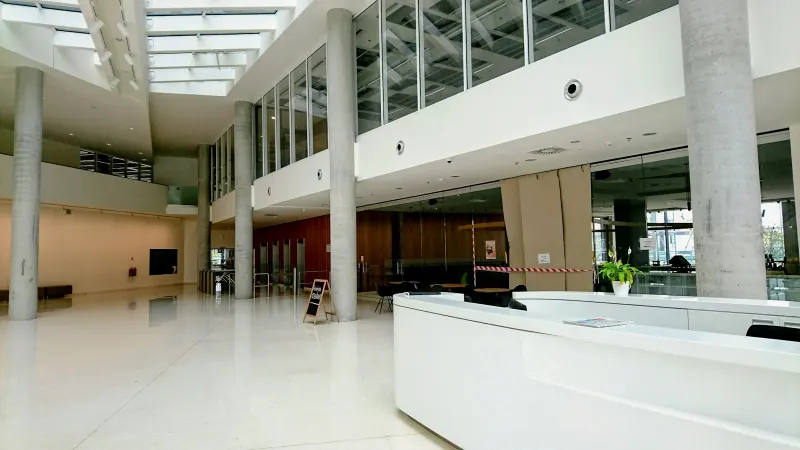
Our partner hospital and hotel
See where you will have your surgery and where you will recover, before you travel.



What you can check before you pay
The hospital
- Accreditation
- JCI-accredited, with the certificate number given to you in writing before any deposit.
- Licence
- Turkish Ministry of Health licence, named and verifiable independently rather than described in general terms.
- Intensive care
- On site, in the same building, for every procedure under general anaesthetic. Not "available nearby".
- Anaesthesia
- A consultant anaesthetist present throughout the operation — not supervising several theatres from elsewhere.
- Nursing
- 24-hour nursing, with an English-speaking nurse on each shift and an interpreter for clinical conversations.
Photos are not proof
Photographs show you the rooms; they do not tell you whether there is an intensive care unit behind them. The facility is named to you in writing before you pay, with its licence and accreditation numbers, so you can verify it as well as see it.
If you want to see the building in person, ask — we can usually arrange a visit before you decide, and a provider unwilling to let you look around is telling you something.
How we verify a facility



How is All-on-4 performed?
Two to three hours per arch under local anaesthetic, with intravenous sedation available. Everything happens in one sitting: extractions, implants and the temporary bridge.
- 1CBCT planning: a 3D scan maps bone volume, the nerve canal in the lower jaw and the sinus in the upper. Implant positions and angles are planned on the scan beforehand.
- 2Anaesthetic: local anaesthetic, with intravenous sedation if you have chosen it. You remain able to respond but will remember little.
- 3Extractions: any remaining teeth in the arch are removed.
- 4Shaping the ridge: the bone ridge is levelled so the bridge will seat properly and the join will not show when you smile.
- 5Placing the front implants: two implants are placed vertically in the front of the jaw, where bone is densest.
- 6Placing the angled implants: two more are placed at the back, tilted up to 45 degrees forward to engage good bone while emerging far enough back to support a long bridge.
- 7Multi-unit abutments: angled connectors are fitted so that all four implants present a parallel platform for the bridge.
- 8The temporary bridge: a pre-prepared acrylic bridge is adjusted, attached and the bite checked. You leave with fixed teeth.
All-on-4 recovery timeline
Expect significant swelling for about a week, soft food for six to eight weeks, and four to six months on the temporary bridge before the permanent one is fitted.
- Days 1–3: swelling and bruising peak around day two and can be marked, particularly on the lower face. Ice, prescribed painkillers and antibiotics.
- Days 3–7: swelling subsides. You eat soft food on the temporary bridge. Rinse gently; do not use a straw.
- Weeks 2–4: most patients feel normal and are back at work. Still soft food only.
- Weeks 6–8: diet can broaden, but nothing hard or crusty on the temporary bridge — acrylic fractures far more easily than the final zirconia will.
- Months 4–6: integration completes and the gums settle. The gum line recedes slightly as swelling resolves, which is precisely why the permanent bridge is made at this point and not earlier.
- After the permanent bridge: full function. Most patients report eating things they had given up years before.
Is All-on-4 in Turkey safe?
All-on-4 is a well-established technique with good long-term data. The main risk is specific to full-arch work: if one implant fails, the whole bridge is affected.
Velsa works with licensed dental clinics in Istanbul whose implantologists are registered with the Turkish Ministry of Health, with in-house CBCT scanning and their own laboratory. You are given your dentist's name and registration number before you pay anything.
Risks you should know about
- Implant failure: under 5%, but the consequence is larger than with a single implant.
- Infection: peri-implantitis around one or more implants, the leading cause of late failure.
- Nerve injury: numbness of the lip and chin in the lower jaw. Rare with proper CBCT planning.
- Sinus perforation: in the upper jaw, which angling the implants is partly designed to avoid.
- Bridge fracture: more likely in acrylic than zirconia, and much more likely if you grind.
- Screw loosening: usually straightforward to retighten, but it needs the right components.
- Speech changes: a full-arch bridge alters tongue space, and most patients adapt within weeks.
- Food trapping: cleaning under the bridge daily is not optional — it is the single biggest determinant of long-term success.
Keep your implant passport and show it to any dentist who treats you. A full-arch bridge needs specific tools and knowledge of the system to service.
Your medical team
Meet your All-on-4 team
You meet your specialist in person before treatment, and they follow your recovery until you are fully healed.
Meet the whole teamAt a glance
What this treatment involves
Free online consultation
Start your All-on-4 journey
- 1Share your detailsFill in the form in under a minute.
- 2Send your photosYour coordinator tells you which photos we need, via WhatsApp or email.
- 3Receive your planA specialist reviews your case and you get a written, all-inclusive quote.
Can All-on-4 be combined with other treatment?
Extractions are almost always part of it, and many patients treat both arches on the same trip. Grafting is usually avoided, which is the point of the technique.
All-on-4 is designed to be a single-stage solution, so there is less sequencing than with individual implants. The main decision is whether to treat one arch or both.
Commonly combined with
- Extractions: nearly always, and done in the same sitting.
- The opposing arch: treating both at once adds one night and avoids a second surgical recovery. It also means the bite is designed as a whole.
- Veneers or crowns on the opposing natural teeth: where you are treating one arch and want the other to match in shade.
- Gum treatment: where periodontal disease caused the tooth loss, it is treated as part of the plan.
Usually avoided
Bone grafting and sinus lifts are what All-on-4 is designed to sidestep. If your CBCT scan shows there is not enough bone even for angled implants, your implantologist may recommend grafting first, or zygomatic implants anchored in the cheekbone — a more specialised procedure with its own trade-offs.
How to prepare for All-on-4
Send a panoramic X-ray before booking, stop smoking, plan both trips, and prepare for six to eight weeks of soft food.
- Panoramic X-ray: send one before paying a deposit. Bone height at the front of the jaw determines whether All-on-4 is possible at all.
- Smoking: stop at least four weeks before and four weeks after. Full-arch failure is far harder to recover from than losing a single implant.
- Medication: declare blood thinners and especially bisphosphonates, which need specialist assessment before jaw surgery.
- Plan both trips: book the second provisionally when you book the first, four to six months later.
- Soft food: plan six to eight weeks of it. Soups, eggs, fish, slow-cooked meat and smoothies.
- Time off: two weeks is comfortable for most people after the first trip; the second trip needs almost none.
All-on-4 results and how long they last
Implant survival at ten years is above 95% in published studies. The bridge itself is the part that wears: acrylic typically needs replacing at around ten years, zirconia considerably longer.
For most patients the change is larger than any other treatment on this site. Fixed teeth that do not move, no palate coverage, and the return of foods that denture wearers give up — apples, steak, crusty bread. The bone preservation matters too: loading the jaw slows the resorption that gives long-term denture wearers a collapsed lower face.
What determines longevity is cleaning. There is a gap between the bridge and the gum that must be cleaned under daily with a water flosser or superfloss, plus a hygienist every six months who knows how to maintain full-arch work. Patients who do this keep their bridges for decades; patients who do not develop peri-implantitis. As consented cases are added, our dental before and after gallery shows cases at both stages.
FAQ
All-on-4 in Turkey: frequently asked questions
At Velsa, £3,200–£4,800 per arch all-inclusive across both trips, or £6,000–£9,400 for both arches. That covers extractions, four implants, the temporary bridge, the permanent bridge, five hotel nights on the first trip and four on the second and all transfers. The same treatment in the UK is typically £9,000–£15,000 per arch.
You get fixed temporary teeth on the day of surgery — a bridge screwed to the implants, not a denture. The permanent bridge is made four to six months later once the implants have integrated and the gums have settled. Both are fixed; only one is final.
Two reasons. The implants need months to bond to the bone before they can carry a rigid final bridge, and the gums shrink as swelling resolves — a permanent bridge made on day three would leave visible gaps within months.
All-on-6 spreads load across more implants and leaves more margin if one fails, which matters most in the upper jaw where bone is softer. All-on-4 costs less and needs less bone. Your CBCT scan and your implantologist should decide this, not the price list.
Closer than a denture by a wide margin — it is fixed, covers no palate and does not move. It will not feel identical to natural teeth, because there is no periodontal ligament and therefore less fine sensation when biting. Most patients adapt within weeks.
Under the bridge, daily, with a water flosser or superfloss, plus brushing as normal. There is a deliberate gap between bridge and gum, and food collects there. A hygienist every six months who is familiar with full-arch work is essential rather than optional.
Temporarily. A full-arch bridge changes the space your tongue works in, and most patients notice a slight lisp for one to three weeks. Reading aloud speeds up the adaptation considerably.
Acrylic on a titanium bar typically ten years before the teeth wear and need replacing. Monolithic zirconia considerably longer — fifteen years or more is common. The implants underneath usually outlast both.
With four implants, losing one normally destabilises the bridge and means revision surgery, often placing a replacement implant and remaking the bridge. This is the main reason to consider All-on-6 if your bone allows it.
Yes, and many patients do. It adds one night to the first trip, avoids a second surgical recovery, and lets the bite be designed as a whole. The recovery is more demanding — expect a fortnight before you feel yourself.
The surgery is done under local anaesthetic, with sedation available, so you should feel pressure rather than pain. Afterwards expect marked swelling for about a week and soreness controlled with prescribed painkillers. Most patients find the first three days the hardest.
For most people, substantially. It is fixed, covers no palate, does not move while eating and preserves jawbone that a denture does not. It is also several times the price and requires surgery, two trips and daily cleaning under the bridge.
Medical disclaimer: This page is for general information only and does not replace a consultation with a qualified surgeon. Prices depend on your individual assessment. Every surgery carries risks, and individual results vary.