

What is breast augmentation?
Breast augmentation is surgery to increase breast volume and improve shape, either with a silicone implant placed through a small incision or by transferring your own fat from another part of the body.
The operation takes one to two hours under general anaesthetic. Your surgeon makes a short incision — most often in the fold underneath the breast — creates a pocket either behind the breast tissue or partly behind the chest muscle, and places the implant. The incision is closed in layers, and most patients stay one night in hospital.
Augmentation adds volume. It does not lift breasts that have dropped significantly: if your nipple sits at or below the breast fold, your surgeon may recommend combining the implant with a breast lift, which lifts and reshapes the breast at the same time.
Implants or fat transfer?
- Silicone implants: the most common choice. They give a predictable, repeatable increase of one to three cup sizes and hold their shape over time. Modern cohesive gel implants hold together even if the shell is damaged.
- Fat transfer: fat is liposuctioned from the abdomen, flanks or thighs, purified and injected into the breast. It avoids an implant entirely and reshapes the donor area, but it gives a modest increase — usually half a cup to one cup — and 30–40% of the transferred fat is reabsorbed.
- Hybrid augmentation: an implant for volume plus a thin layer of fat over it to soften the edges. Useful for slim patients with little natural breast tissue.
Implant shape, surface and placement
- Round implants: fuller in the upper part of the breast, giving more cleavage and a more obvious result.
- Anatomical (teardrop) implants: more volume at the bottom, following the natural slope of the breast.
- Smooth surface: the current standard. Textured implants are now used rarely because of their association with a rare immune-system cancer, BIA-ALCL.
- Placement: subglandular (behind the breast tissue), submuscular (behind the chest muscle) or dual plane, which is a combination. Submuscular and dual plane give a softer upper edge and interfere less with mammograms, and are usually preferred in slimmer patients.
Velsa works with Mentor, Motiva and Polytech implants. All three carry a manufacturer warranty that is valid internationally, and you receive the implant passport with your batch numbers before you fly home.
Where the implant sits
Over the muscle
Quicker recovery, but the edge can show through thin tissue
Under the muscle
More natural upper slope and better coverage, with a longer recovery
Dual plane
Muscle covers the top, tissue the bottom — the usual choice
How much does breast augmentation cost in Turkey?
A Velsa all-inclusive breast augmentation package in Istanbul costs £2,400–£3,600. The equivalent operation in a UK private hospital is typically £6,000–£8,000, and in the United States $8,000–$12,000.
| Procedure | Price (GBP) | Hospital nights | Nights in Turkey |
|---|---|---|---|
| Breast augmentation, round implants | £2,400–£2,900 | 1 | 6 |
| Breast augmentation, anatomical implants | £2,700–£3,200 | 1 | 6 |
| Hybrid augmentation (implant + fat) | £3,100–£3,600 | 1 | 7 |
| Fat transfer only | £2,600–£3,300 | 1 | 6 |
| Augmentation with breast lift | £3,400–£4,400 | 1–2 | 7 |
What the package includes
- Surgeon and anaesthetist fees
- One night in a private hospital room
- Implants with international warranty
- All pre-operative blood tests and scans
- Five nights in a four-star hotel with breakfast
- All airport, hotel and hospital transfers
- A personal English-speaking coordinator
- Post-operative surgical bra and medication
- Follow-up appointment before you fly home
- Twelve months of remote aftercare
What is not included
Flights are not included, so you can book the fare and route that suit you. Also excluded are travel insurance that covers elective surgery abroad, meals outside hotel breakfast, and any revision surgery, which is quoted separately. There are no consultation fees at any stage.
What it costs elsewhere
£2,400–£3,600
All-inclusive with Velsa: surgeon, hospital, hotel, transfers and twelve months of aftercare
£4,200+
Typical saving against the UK, mid-range against mid-range, before flights
58%
Less than the typical UK price
Bars span the usual range in each market, not a single quoted figure. Non-Turkish figures are indicative market ranges rather than quotes from named providers.
US and UK figures are typically the surgeon and facility only. Flights, accommodation, transfers and follow-up are extra in those markets and included in the Velsa price, which is the comparison that actually matters.
Your own price comes from a written quote after a clinician has reviewed your case. Nothing on this chart is a quote.
Why do patients from the UK, US and Europe choose Turkey?
Patients choose Turkey for lower all-inclusive prices, experienced plastic surgeons who operate at high volume, modern private hospitals, short waiting times and easy direct flights from most European and many US cities.
Turkey has become one of the world's leading medical travel destinations. According to Turkish industry figures reported in July 2026, the country welcomed around 1.4 million health tourists in 2025, generating over $3 billion in revenue. Aesthetic surgery is one of the most requested categories.
- Value: lower operating and living costs mean you pay less for the same type of surgery and hospital care.
- Experience: leading surgeons in Istanbul and other major cities perform aesthetic operations every week.
- Speed: consultations can be arranged online within days, and surgery dates are flexible.
- Access: most UK and European airports have direct flights of around 3–4 hours.
- Recovery comfort: you recover in a hotel with a coordinator on hand, rather than managing alone at home.
Every Velsa quote names the surgeon and the hospital before you pay, so you can check both yourself.
Am I a good candidate for breast augmentation?
The best candidates are in good general health, at a stable weight, have finished having children, and want a change in size that is realistic for their frame and the amount of breast tissue they already have.
Breast augmentation is usually suitable if
- You are over 18 — and over 22 for silicone implants, which is the usual international guidance.
- Your breasts are fully developed and your size has been stable for at least a year.
- You feel your breasts are too small for your frame, or lost volume after pregnancy or weight loss.
- One breast is noticeably smaller than the other and you would like them more even.
- You are a non-smoker, or can stop at least four weeks before surgery.
- Your expectations are realistic: an implant adds volume and fullness, not a lift.
You may need to wait, or consider something else
- You are pregnant or breastfeeding: wait at least six months after you stop.
- You are planning a pregnancy soon, which can change breast size and shape again.
- Your nipple sits below the breast fold: a lift, with or without an implant, will give a better result.
- You have an untreated breast lump, or a mammogram that has not been followed up.
- You have a significant untreated health condition, or a BMI over 35.
Not sure which category you fall into? The one-minute self-check below gives you an honest answer, and a Velsa surgeon reviews your photographs free of charge before you commit to anything.
1-minute self-check
Am I a good candidate for breast augmentation?
Answer 7 quick questions to see if breast augmentation could be right for you. No personal details needed to see your result.
Your breast augmentation journey in Turkey, day by day
From landing to flying home is usually six nights in Istanbul. Here is exactly what happens, and when.
- 1Before you travel: you send photographs and a short medical history. A plastic surgeon reviews them and recommends an implant size, shape and placement. You receive a written, fixed quote and, once you are happy, choose your dates.
- 2Day 1 — arrival: your driver meets you at Istanbul airport and takes you to the hotel. Nothing medical happens today; rest after the flight.
- 3Day 2 — consultation and surgery: blood tests, an ECG and a chest check in the morning, then a face-to-face consultation where you try implant sizers in a bra to agree the final size. Surgery is the same afternoon. You wake in your private room with a surgical bra already fitted.
- 4Day 3 — discharge: your surgeon reviews the dressings and discharges you to the hotel. You will feel tight across the chest and tired, but able to walk.
- 5Days 4 to 6 — rest: gentle walking, no lifting. Your coordinator checks on you daily and is on WhatsApp at any hour.
- 6Day 7 — final check and fly home: dressings are changed, your surgeon confirms you are fit to fly, and you receive your implant passport, medication and written aftercare instructions.
- 7After you are home: a nurse checks in at one week, six weeks, three months and twelve months. Your surgeon reviews photographs at each stage and is reachable throughout.
Where you will be cared for
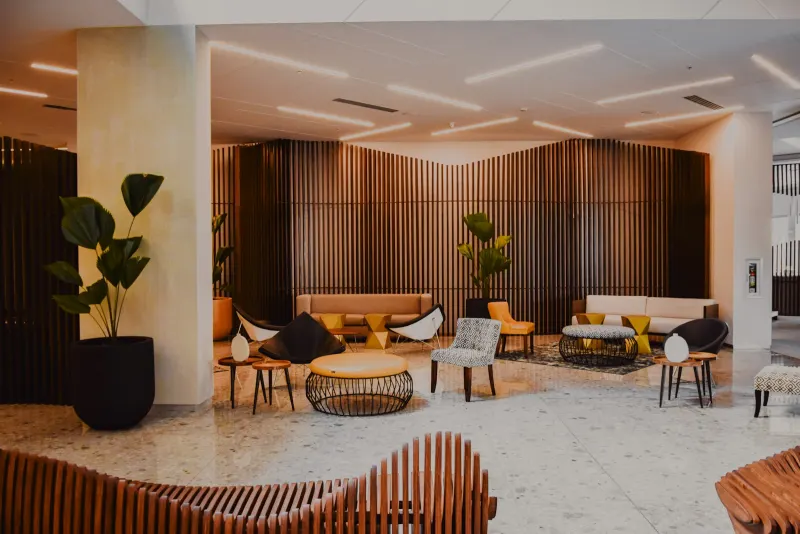
Our partner hospital and hotel
See where you will have your surgery and where you will recover, before you travel.


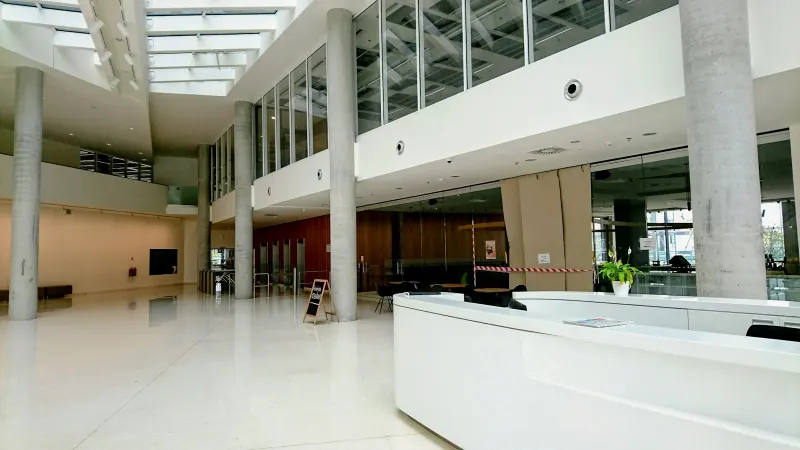

What you can check before you pay
The hospital
- Accreditation
- JCI-accredited, with the certificate number given to you in writing before any deposit.
- Licence
- Turkish Ministry of Health licence, named and verifiable independently rather than described in general terms.
- Intensive care
- On site, in the same building, for every procedure under general anaesthetic. Not "available nearby".
- Anaesthesia
- A consultant anaesthetist present throughout the operation — not supervising several theatres from elsewhere.
- Nursing
- 24-hour nursing, with an English-speaking nurse on each shift and an interpreter for clinical conversations.
Photos are not proof
Photographs show you the rooms; they do not tell you whether there is an intensive care unit behind them. The facility is named to you in writing before you pay, with its licence and accreditation numbers, so you can verify it as well as see it.
If you want to see the building in person, ask — we can usually arrange a visit before you decide, and a provider unwilling to let you look around is telling you something.
How we verify a facility



How is breast augmentation performed?
The operation takes one to two hours under general anaesthetic, and almost always uses an incision hidden in the fold beneath the breast.
- 1Marking: with you standing, your surgeon marks the breast fold, the midline and the planned pocket. This is done the morning of surgery and takes about fifteen minutes.
- 2Anaesthetic: a consultant anaesthetist puts you to sleep. You are monitored throughout and for the first hours afterwards.
- 3Incision: a 4–5 cm cut is made in the inframammary fold, where the scar is hidden by the breast itself. A periareolar incision, around the lower edge of the nipple, is an alternative in some cases.
- 4Creating the pocket: the surgeon lifts the breast tissue, and in a dual-plane or submuscular approach releases the lower edge of the pectoral muscle, creating a space exactly the size of the implant.
- 5Sizing and placement: a temporary sizer confirms the result while you are on the table. The implant is then inserted — usually with a Keller funnel, a no-touch technique that reduces contamination — and positioned.
- 6Checking symmetry: you are sat upright on the operating table so your surgeon can compare both sides before closing.
- 7Closing: the incision is closed in three layers with dissolving sutures, and a surgical bra is fitted before you wake. Drains are rarely needed.
Breast augmentation recovery timeline
Expect to feel tight and sore for about a week, back at a desk in 7–10 days, and back to full exercise at six weeks. The final shape settles between three and six months as the implants drop into position.
- Days 1–3: tightness across the chest, like a hard workout. Pain is controlled with simple painkillers. You can walk, eat normally and shower from day three.
- Week 1: swelling peaks around day three then begins to settle. Sleep on your back, slightly propped up. No lifting anything heavier than a kettle.
- Weeks 2–3: most patients are back at a desk job and driving. Bruising fades. You wear the surgical bra day and night.
- Weeks 4–6: light exercise such as walking and cycling can restart. No chest or shoulder work, no running, no lifting children.
- Weeks 6–8: full exercise, including upper-body training, with your surgeon's approval. You can move to a normal supportive bra.
- Months 3–6: implants settle into their final position — the "drop and fluff" — and the upper fullness softens into a natural slope. Scars begin to fade.
Is it safe to have breast augmentation in Turkey?
Breast augmentation is one of the most performed operations in the world and complications are uncommon, but it is real surgery with real risks — and implants are not lifetime devices.
Velsa works only with JCI-accredited private hospitals in Istanbul and with plastic surgeons registered with the Turkish Ministry of Health who hold Turkish Society of Plastic, Reconstructive and Aesthetic Surgeons membership. You are given your surgeon's name and registration number before you pay anything.
Risks you should know about
- Capsular contracture: scar tissue tightens around the implant, making the breast firm or distorted. Affects roughly 1 in 20 patients.
- Implant rupture: uncommon with modern cohesive gel, and usually silent — found on a scan rather than felt.
- Changed nipple sensation: temporary numbness is common; permanent change affects a small minority.
- Rippling: visible edges or waves, most likely in slim patients with thin tissue and subglandular placement.
- Infection or haematoma: uncommon, but may need a return to theatre.
- Asymmetry: breasts are never identical, and a small difference usually remains.
- BIA-ALCL: a rare lymphoma linked to textured implants. Velsa uses smooth implants.
- Blood clots: the reason for compression stockings, early walking and a six-night stay.
Implants do not prevent breastfeeding for most women, and they do not cause breast cancer. They can make mammograms harder to read, so tell your radiographer you have implants — extra views are taken.
Your medical team
Meet your breast augmentation team
You meet your specialist in person before treatment, and they follow your recovery until you are fully healed.
Meet the whole teamFree online consultation
Start your breast augmentation journey
- 1Share your detailsFill in the form in under a minute.
- 2Send your photosYour coordinator tells you which photos we need, via WhatsApp or email.
- 3Receive your planA specialist reviews your case and you get a written, all-inclusive quote.
Can breast augmentation be combined with other procedures?
Yes, and combining is often the better choice: one anaesthetic, one recovery and one trip. Your surgeon will tell you honestly how much can be done safely in a single operation.
The most common combination is augmentation with a breast lift, for patients who want both volume and a higher nipple position. A mommy makeover adds a tummy tuck, and is popular with patients whose body changed after pregnancy.
Commonly combined with
- Breast lift: when the nipple sits at or below the breast fold. Adds roughly £1,000 and one night to the package.
- Tummy tuck: the classic mommy makeover. Total theatre time rises to around five hours, and the stay extends to seven nights.
- Liposuction: often used to harvest fat for a hybrid augmentation, reshaping the waist at the same time.
- Arm lift or thigh lift: possible, but your surgeon will usually ask you to split these across two trips to keep total operating time safe.
There is a limit. Most surgeons will not operate for more than six hours in one sitting, because longer anaesthetic time raises the risk of clots and wound problems. If your wish list is too long, Velsa will say so and plan two trips rather than take the risk.
How to prepare for your breast augmentation
Stop smoking and nicotine at least four weeks before surgery, review your medication with your surgeon, arrange a week of real rest, and pack front-opening clothing.
- Medication: tell your surgeon everything you take. Blood thinners, anti-inflammatories, the combined pill and some supplements may need pausing.
- Smoking: nicotine in any form — including vapes and patches — reduces blood flow to the skin and significantly raises the risk of wound-healing problems.
- Time off: plan 10 days away from work and 6 weeks away from the gym, heavy lifting and lifting small children.
- Breast screening: if you are over 40, or have a family history, have a mammogram or ultrasound before you travel.
- Packing list: front-opening or zip tops, slip-on shoes, a travel pillow, compression stockings, and your regular medication in its original packaging.
Breast augmentation results and scars
Results are immediate but not final: the implants sit high and firm at first, then drop into a natural position over three to six months. The scar is permanent, sits in the breast fold, and usually fades to a fine pale line.
Implants themselves do not age, but your breasts do. Weight change, pregnancy and gravity will keep altering the shape of the breast tissue around the implant, which is why some patients choose a lift or an exchange years later. Keeping your weight stable and wearing a properly fitted supportive bra for sport makes a measurable difference.
Scars are pink and firm for the first three months, then flatten and lighten over 12 to 18 months. Silicone gel or tape from week three, plus strict sun protection, improves the final appearance. As consented cases are added, our breast surgery before and after gallery shows how scars settle at different stages.
FAQ
Breast augmentation in Turkey: frequently asked questions
At Velsa, breast augmentation costs £2,400–£3,600 as an all-inclusive package. That covers the surgeon, anaesthetist, one night in a private hospital, branded implants with an international warranty, five hotel nights, all transfers and twelve months of aftercare. Flights are not included.
Six nights. One night in hospital and five in the hotel, so your surgeon can check the wound and confirm you are fit to fly before you leave.
Implants are measured in cubic centimetres, not cup sizes, and the right volume depends on your chest width and existing tissue as much as on the look you want. Most patients choose between 250 cc and 400 cc, which is roughly one to two cup sizes. You try sizers in a bra at your face-to-face consultation before anything is decided.
Most women can. The inframammary incision and a submuscular or dual-plane pocket leave the milk ducts and glandular tissue largely undisturbed. No surgeon can guarantee breastfeeding, with or without implants, so tell your surgeon if you are planning a pregnancy.
Most patients describe tightness and soreness rather than sharp pain, similar to an intense chest workout. It is worst for the first 48 hours and controlled with simple painkillers. Submuscular placement is more uncomfortable in the first week than subglandular.
No — that is a myth. Implants have no expiry date and are not replaced on a schedule. However, around one in five women needs further surgery within ten years for a complication or a change of mind, so it is sensible to plan for the possibility.
Velsa includes twelve months of remote aftercare: nurse check-ins at one week, six weeks, three months and twelve months, with your surgeon reviewing photographs. Beyond that, UK guidance suggests an MRI or ultrasound every few years to check silicone implants, which you arrange locally.
You can, and many women do. Be aware that pregnancy and breastfeeding can change breast size and skin quality again, so you may want further surgery afterwards. If children are planned within a year or two, most surgeons suggest waiting.
Contact your coordinator first, at any hour. Minor issues are managed remotely with your surgeon. If you need to be seen, Velsa arranges a local review and, where the problem relates to the surgery, a revision in Istanbul with flights and hospital covered under the aftercare terms in your written quote.
Mentor, Motiva and Polytech. All are CE-marked, used routinely in UK and European practice, and carry an internationally valid manufacturer warranty. You receive the implant passport with your batch numbers before you fly home.
Yes, if you want a modest increase of about half a cup to one cup and have enough donor fat on the abdomen, flanks or thighs. It avoids an implant and reshapes the donor area, but 30–40% of the transferred fat is reabsorbed, and a second session is sometimes needed.
It is, provided the hospital is accredited, the surgeon is registered and verifiable, and you stay long enough for a proper post-operative check. The real risks of medical travel are flying too early and having nobody to call afterwards — which is why Velsa books six nights and includes twelve months of aftercare.
Medical disclaimer: This page is for general information only and does not replace a consultation with a qualified surgeon. Prices depend on your individual assessment. Every surgery carries risks, and individual results vary.